Showing posts with label religion. Show all posts

Thursday, May 29, 2025

Moon Men and a Calendar System for King of Kings


Moon Man
Number Encountered: 2d8
Hit Dice: 3+1
Attacks: 2 claw (1d6) OR 1 claw (1d6) + 1 crystal ray (2d6 + see below)
Armor: as chain
Morale: 8
Canine Disdain: If dogs or wolves are involved in a fight with moon men, they have disadvantage on morale checks. However, once a moon man kills even a single dog or wolf in combat, this penalty goes away.
Crystal Ray: 50% of moon men encountered from a moon beam expedition will be wielding pale purple crystals in one hand. These crystals, when focused on a target, emit a warbling ray that deals 2d6 HP damage and 1d4 STR damage on a failed save.
Ill-Suited: Moon men are heavy and clumsy when on the earth. On the earth, moon men will never win chases, ranged attacks have advantage to hitting them, and their claw attacks have disadvantage.
Moon Beam: Moon men crawl down on moon beams to explore and raid the surface of the earth. As a result, moon men can only ever be encountered on the night of a full moon. They grow incredibly sickly and weak if left "down below" for too long. 
Raiding: Moon men venture "down below" to steal animals and kidnap people to take to the moon as slaves. They also covet fine and careful craftsmanship. They can be bargained with, although the communication barrier presents problems.
 
The moon is an evil rock that glares down balefully, and on those nights when its soft, pale, quite pleasant but nonetheless cruel light shines down most brightly on the world, some of its cruel inhabitants can crawl down the strongest of moonbeams and raid what they call "down below." Moon men are hunched over ape-like things with nasty teeth and a hard insectile carapace, slimy red gills pulsating on their squat necks. Up on the moon, they bound through the waving purple grasses like baboons, but down here the heaviness of our world weighs them down significantly. Nevertheless, they brave the difficulty in order to get that which they lack up above: cattle, goats, chickens, and slaves. The closest thing to a domesticated animal that the moon men have are the half-intelligent moon-beasts, which produce a thick milk that forms the basis of the moon man diet, but moon-beasts refuse to do hard work. So, lacking other options, they steal from us. As if living on the edge of the Empire, at risk of raids from desert nomads or dog-headed men wasn't bad enough!
 
With their limitations down below, however, capturing slaves or even just cows is very difficult. So, some moon men (usually higher-status ones) bring crystals that glow with a baleful energy which burns the skin and withers the bones. By tuning their sensitive teeth to the frequencies of the crystals, these moon men can aim a focused ray of withering energy at a single target. Very often, this ray brings a poor peasant right to the door of death, with just about every inch of skin blackened, but this just makes the moon man's job easier. Once their quarry is completely weakened, they tie them up with purple grass-ropes and drag them back up the moon beam, letting them soak in a healing ooze made from moon-beast milk to bring back their strength and vitality before putting them to work. Since their goal is to enslave humans, generally they will avoid actually killing their target, so even when someone is tied up, a deal may be struck for their release, especially if fine filigreed gold and silver is offered (since their clumsy claws can do no fine handiwork). Very often, however, a family gives up their precious heirloom in exchange for their son or daughter's freedom, only to be raided again on the next cloudless full moon night. It is exceedingly rare for a poor slave to be carted off to the moon and escape to return down below, but there are many who will claim such extraordinary things.
 
These moon men definitely don't look like Ray Harryhausen's selenites, but you know I gotta include them somehow

-------------
 
Since moon men can only be encountered on the night of the full moon (unless one was captured and kept in captivity in between), I figured its about high time I write up a calendar for King of Kings, something I've been meaning to do for quite some time!
 
The Enlightened Empire (and along with it most of the societies around it; in my heart of hearts I'd love to write out alternate calendars that like, the Gnostic Elves or the Great East or the dog-headed men use but also I'd be crazy to try and use that in gameplay) uses a lunisolar calendar, 12 months of 30 days with a 13th intercalary month inserted every 4 years, to ensure the calendar more or less lines up with the flow of the seasons. This does mean the average year length is 367.5 days, which is longer than IRL, but for the purposes of running a D&D game I don't want to deal with the metonic cycle, so I can fudge the math a bit, and anyway this is a fantasy world. Every month begins on a new moon (which, since the world in King of Kings is flat, is the literal darker side of the moon turning to face the earth; rather than light being blocked from hitting it, dark clouds are accumulated on one side of the moon, and it takes 30 days for the moon to fully rotate). The year begins on the first new moon after the spring equinox (the midpoint in the sun's procession from its closest point to the world (summer) and its farthest point (winter); the sun moves in a recurring spiralling motion around the world), with a grand New Year festival of varying length taking place in the period between the equinox and the new moon.
 
Diagram showing the metonic cycle, 9th century manuscript from St. Emmeram's Abbey, Bavaria

The 12 (13) months are:
1: Ashabehesht ("the best for Truth," dedicated to Truth in both its abiding and creating aspects; roughly corresponding (if this was our world) to the latter half of March-first half of April)
2: Thuravahr ("month of strong spring"; roughly April-May)
3: Thaigrasihr ("garlic-collecting month"; roughly May-June)
4: Hordad ("wholeness" or "perfection," an aspect of Truth; roughly June-July)
5: Amardad ("immortality," an aspect of Truth; roughly July-August)
6: Shahrivar ("guardian of metals," an aspect of Truth, considered an auspicious month to begin a war; roughly August-September)
7: Mihr (month dedicated to thousand-eyed Mihr, protector of covenants, and considered an auspicious month to begin a war; roughly September-October)
8: Marukashan ("wolf-killing month"; roughly October-November)
9: Aban ("water"; roughly November-December)
10: Azar ("fire"; roughly December-January)
11: Wahman ("good purpose," an aspect of Truth; roughly January-February)
12: Spandarmad ("holy devotion," an aspect of Truth; roughly February-March)
Intercalary: The Month of the Nameless One (the one month still allowed the chthonic gods, after the dedication of most other months to aspects of Truth)
 
For official capacities (i.e. the imperial court, the temples, satraps and their hangers-on, etc.), days are reckoned by simple numbering of days each month (i.e. 1 Shahrivar). In real life all 30 days of a month in the Zoroastrian calendar are given a unique name, and that would be really cool and evocative, but its just unfeasible for game purposes. (As an aside, check out this gallery of beautiful calligraphy of the ancient month day names.) The above month names are derived from either the 12 months of the Zoroastrian calendar (but using Middle Persian equivalents for the Avestan names, with some minor modifications) or the months we know from the Old Persian calendar from the Achaemenid period (with names turned into (an approximation of) Middle Persian equivalents; unlike the Zoroastrian calendar, we don't have actual MP versions, so I kinda had to speculate on what the Old Persian words would evolve into; also some of those months (like the "wolf-killing month") we only know from Elamite-language inscriptions, so I kinda had double the speculation there). I get way too into doing research for verisimilitude for things like this. Needless to say, though, while the above takes inspiration from historical and present Iranian calendars, it shouldn't be taken on face value as an accurate reflection on them, Iranian culture, or Zoroastrianism, this is an entirely fictional system of tracking time made for a D&D game.
 
For the purposes of moon man encounters (and werewolves, while we're at it!), the full moon (both when its at its fullest and when it is technically not a true full moon but still appears full to the eye) lasts from the 14th to the 16th of each month.
 
High-relief depicting the royal investiture of Shahanshah Khosrow II, with Mithra (Mihr) to his right and (probably) Nahid (Anahita) to his left, from Taq-e Bostan, Kermanshah, Iran

Commoners, especially rural peasants, on the other hand, use a 7-day week system to mark the time between regular market days.  The weekdays are:
1: Gandom Roz ("wheat/grain day," the market day around which the rest of the week revolves. While other weekdays are dedicated to certain common deities, each village or town's market is governed by a local tutelary deity.)
2: Hvar Roz/Asha Roz ("sun day" or "truth's day," since the sun is often conflated as a manifestation of Truth.)
3: Mah Roz ("moon day," the most scandalous element of the peasant week, at least to the priesthood, since the moon is widely known to be evil.)
4: Tir Roz ("Sirius' day," dedicated to Tir, conflated with the star Sirius, as god of rains.)
5: Mihr Roz ("Mihr's day," dedicated to thousand-eyed Mihr, protector of covenants and watcher of livestock.)
6: Bahram Roz ("Victory's day," dedicated to Victory, conflated with the Red Wanderer, as god of... well, victory.)
7: Nahid Roz ("Morning Star's day," dedicated to Nahid, conflated with the Morning Star, as goddess of love, sex, and bloodshed.)
 
Check out the page on the week in Encyclopaedia Iranica for more information about the historical inspirations behind this system of days, namely the Sogdian week. Also, keep an eye out for a future post about the major divinities of the Enlightened Empire!
 
Mosaic zodiac wheel from the floor of the Byzantine-era Beit Alpha synagogue in northern Palestine

And, finally, since I'm sure this is more than enough lists of things for one post, the zodiac of the world of King of Kings:
1: The Lamb (12 Ashabehesht to 11 Thuravahr)
2: The Bull (12 Thuravahr to 11 Thaigrasihr)
3: The Mirror (12 Thaigrasihr to 11 Hordad)
4: The Crayfish (12 Hordad to 11 Amardad)
5: The Lion (12 Amardad to 11 Shahrivar)
6: The Grasses (12 Shahrivar to 11 Mihr)
7: The Emerald (12 Mihr to 11 Marukashan)
8: The Scorpion (12 Marukashan to 11 Aban)
9: The Simurgh (12 Aban to 11 Azar)
10: The Goat (12 Azar to 11 Wahman)
11: The Serpent (12 Wahman to 11 Spandarmad)
12: The Fish (12 Spandarmad to 11 Ashabehesht; during a leap year, all of The Month of the Nameless One is considered to fall under the sign of the Fish)
 
When creating a character, roll 1d12 to determine which star your character was born under the auspices of. This gives ability score modifiers, gives advantage on a certain type of roll only when the sun is in one's sign, and describes (or at least gives a prompt for) your character's personality:
1: The Lamb (+1 WIS, -1 STR; adv. on saving throws vs. mind-altering effects; meek yet determined, born with a poem in their ear)
2: The Bull (+1 CON, -1 DEX; adv. on saving throws vs. poison and paralysis; intensely stubborn, loyal, and handsome)
3: The Mirror (+1 CHA, -1 DEX; ranged attacks have disadv. against you; self-absorbed, confident, a fragile leader with careless fingers and careless lips)
4: The Crayfish (+1 DEX, -1 WIS; adv. on finding and disarming traps; quick-witted and observant but comfortable in their ways)
5: The Lion (+1 CHA, -1 INT; adv. on hireling loyalty checks; physically strong and boisterous, a natural leader, but not one who always makes the right decision)
6: The Grasses (+1 DEX, -1 STR; melee attacks have disadv. against you; always willing to join up with anything, never quite good enough to excel)
7: The Emerald (+1 WIS, -1 CHA; adv. on initial reaction rolls; as many faces as a jewel has facets, rich in personality but not in friends)
8: The Scorpion (+1 CON, -1 CHA; adv. on damage rolls; hardscrabble and selfish, a poison barb at the ready for those who threaten them and theirs)
9: The Simurgh (+1 CHA, -1 CON; adv. on any save or die roll; kindly and caring, perhaps too willing to give up for others)
10: The Goat (+1 INT, -1 WIS; adv. on saving throws against traps; too smart for their own good, always finding a way into and out of trouble)
11: The Serpent (+1 INT, -1 STR; adv. on ranged attacks; intelligent and skillful, always has a plan up their sleeve, often seen as conniving)
12: The Fish (+1 WIS, -1 DEX; opponents have disadv. on morale checks; an inauspicious sign ever since the Deluge, those born under the Fish are slow and quiet, yet thoughtful and observant, often seeing in the big picture rather than the here-and-now)
 
And, well, that's enough for now. I want to make tracking in-game time really matter, so I figure this is a good start, with a monster encounter and player-facing rolls affected by the calendar, but there will likely be more in the future! I especially want to figure out ways to make the calendar connect to magic, since magic in King of Kings is derived from the stars. Anyway, hope this has been at least kinda interesting!

Wednesday, February 26, 2025

False Prophets (A Monster for King of Kings)

Onkelos then went and raised Jesus the Nazarene from the grave through necromancy... Onkelos said to him: What is the punishment of that man, a euphemism for Jesus himself, in the next world? Jesus said to him: He is punished with boiling excrement. As the Master said: Anyone who mocks the words of the Sages will be sentenced to boiling excrement. And this was his sin, as he mocked the words of the Sages.
-Gittin 57a, Bavli Talmud

In Gehenna there are certain places and grades called "Boiling Filth" [Tzoah Rotachat], where the filth of the souls that have been polluted by the filth of this world accumulates... There are certain sinners who pollute themselves over and over again by their own sins and are never purified. They die without repentance, having sinned themselves and caused others to sin, being stiff-necked and never showing contrition before the Lord while in this world; these are they who are condemned to remain for ever in this "boiling filth" and never leave it. Those who have corrupted their ways upon earth and recked not of the honour of their Lord in this world are condemned to remain there for all generations.
 -Terumah 41, Zohar

I can't find any artistic depictions of Tzoah Rotachat, but this painting of a Buddhist hell (Naraka) gets the boiling across pretty well.

False Prophet
Number encountered: 1
Hit Dice: 3+1
Attacks: 1 inveighing OR 1 exhortation OR 1 spell
Armor: as leather
Morale: 8
Daeva-summoned: Deceitful daevas summon false prophets as thralls to do their bidding.
Followers: False prophets are accompanied by 2d4 sycophantic followers, most often 1 HD undead sinners.
Foul Stench: Those engaged in melee or grappling with a false prophet have disadvantage on rolls due to the foul stench, unless they block their sense of smell in some way.
Inveigh: False prophets have the deceitful power to inveigh against some immorality and insidiously bind others against it. When inveighing, the false prophet declares some specific action (i.e. slashing with a sword, casting a healing spell, jumping, etc.) to be anathema, stopping completely any attempt to perform the specific action. Only one action can be inveighed against at a given time; when the false prophet inveighs against something else, it overrides the earlier inveighing. Spells such as remove curse or dispel evil will counteract an inveighing. 
Exhort: False prophets can exhort their followers to their greater mission. An exhortation gives the false prophet's followers advantage on morale checks and can (if declared after an inveighing) carve out an exception in an inveighing for the false prophet's followers and allies. 
Spells: Instead of an inveighing or motivation, a false prophet can choose to cast a spell. False prophets know spells such as darkness, cause fear, cause light wounds, insect plague, although the specific spell list will vary.
 
On the underside of the world, pools of boiling filth and waste hold the writhing bodies of false prophets, the most deceitful of men and women, those who inveighed against Truth and led others toward Deceit. Truth places them there, keeping them as far as possible from the light of the sun, in the company of chaos-loving daevas and other underside-dwellers. After centuries of upside-down boiling torment, false prophets have become accustomed to the pain, although the comparative euphoria of simply not being immersed in their fetid pits even for just a moment is something they can never pass up. These priests of treachery, boiling away on the bottom of the world, are sometimes dragged out to their delight by daevas and sorcerers to use their unwholesome influence, answer forbidden questions, or simply do dirty work perfect for their already soiled hands.
 
Since false prophets (of the long-dead sort) are only ever on the surface world at the behest of terrible powers, they are never encountered alone. Gibbering sycophants crowd around them and hold them aloft, ignorant of the slimy filth dripping off their bodies. Uncanny daevas, walking upside-down on ceilings and causing disease, give them orders (some even holding an excrement-encrusted false prophet on a bejeweled leash), while pale eyeless things adapted to the deep depths between the underside of the world and the surface crawl along with the entourage, caught up in the movement of it all. Sea Tyrants and their servants, unfortunate bedfellows of the daevas, look down on false prophets as failed upstarts, barely tolerated presences kept only so long as they are useful.
 
a Not false prophet: Horace Vernet's Jeremiah on the Ruins of Jerusalem (I just really liked this painting and wanted to put it somewhere)

10 of the Most Perfidious False Prophets
  • Abonoteichos the Wrong: Condemned for passing himself off as an oracle, mocking divination with the writhing of serpents and his made-up god Glukos, cannibal snake-god of bread.
  • Shekh el-Mal of the First City: Frogling prophet condemned for attempting to make a god out of money.
  • Yusuf bar Kham: Condemned for leading ten thousand of his own followers to leap from Mount Garza to their deaths when his rebellion failed.
  • Myops the Annoyance: Condemned for leading the children of his city-state astray, causing the collapse of the city walls.
  • Amamba Rhos: Mythic ancestor of the Gnostic Elves, declared retroactively condemned by the priesthood for the sins of her descendants (the Elves, of course, dispute this).
  • Ugarza the Betrayer: Frogling prophet infamous for seizing control of an ancient city and casting down the stone stelae of the law codes, shattering them upon the ground.
  • Sajah bint Haytham: Condemned for demanding that Truth in the sky pay taxes to her and her desert kingdom.
  • Fravarti of Guoxes: Condemned for whipping up the people into a frenzy against a Truthful prophet, who was hanged from an elm tree.
  • Babak Nokh the Perverse: Condemned for establishing an impure commune that advocated sex with crocodiles and the eating of cats.
  • Khura the Star-Eraser: Condemned for roping his followers into a scheme to climb into the sky and erase certain stars he felt were distasteful.

Monday, May 22, 2023

The World of King of Kings: A Brief Timeline and the Enlightened Empire

7th century silver and gold bowl depicting a King of Kings hunting

I've been meaning to get back on writing King of Kings posts, namely world building posts to fill in a lot of the big foundational gaps that have been left in my approach to writing about it on the blog up to now. So here we have a series of posts about the major empires and states of the KoK world, beginning with a brief timeline and description of the Enlightened Empire, the vast realm in which KoK is set. There'll be six of these polity posts, so look out for those when they come by!

But, to begin with, a bit of a reflection. I'm constantly struggling to balance my love for writing world building detail, evocative elements, and things that bring verisimilitude to a setting, with the need to primarily write things that can actually be gameable or primarily just contribute to inspiration rather than telling a referee or reader exactly what to do with a setting. That's been on my mind for a while, but was most clearly brought forward with Prismatic Wasteland's post Lore! What is it Good For? I really want to write lore, in a broad sense, for King of Kings, but also not just make it a boring Forgotten Realms Dragonlance Mystara gazetteer y'know? So, my hope in these posts is to try and strike a balance. Future posts in this series will center on things like character backgrounds, random encounters, and rumors about a given part of the world from the perspective of those in the eastern satrapies. While I'll be writing about places that can be really far afield from where my game currently is, the goal is to always tie things back to the needs of the game.

This first post won't have as much of that, because it is about the very empire that the King of Kings game is set in; it will be given much more detail in plenty of more posts about the game!

Noah and his Ark, from a 16th century Mughal miniature

A BRIEF OVERVIEW OF AGES AND YEARS SINCE THE DELUGE
[This is meant as a small set of events to anchor the world's history on, not a comprehensive history that players would need to memorize.]
Roughly 1,000 years ago, the dreadful Sea Tyrants flooded the world with their sinister star magic, in a last ditch attempt to seize control of all the world. This is the start of history, as before the Deluge there are only vague myths, and a world almost unrecognizable. The First City, now capital of the Enlightened Empire, was able to survive the Deluge with magic stolen for them by a promethean Traitor Frog, ancestor of the Froglings, ensuring the survival of humanity and other land animals. In the Empire of the Great East, they have a different telling; that a sagely lord and his family went to the top of the tallest mountain in the world and made a deal with a great Olm and a Dragon to channel the waters into the Great East's two rivers, draining the land before it could even flood completely.

The below is a general timeline of years since the Deluge:
0-150: The Age of Heroes, wherein half mythic warriors and newly born sorcerers began to seize holdings for themselves, slay lingering batrachian horrors left all over by the Deluge, and scout out the first spells and rituals.
150-400: The Age of Tyrants, wherein the sons and daughters of the Heroes rule arbitrarily and with the legitimacy of their Heroic descent. Tyrant is here meant not solely as a pejorative, though many rulers in this period were murderous despots. Kingdoms rise and fall. This era is when the Dinosaur Kings ruled over what are now the eastern satrapies.
400: Invasion of the Conquering King, wherein the great Ruler of the World conquered most of the known world (other than the Empire of the Great East), from his island homeland in the western archipelago. He would die without an heir and leave his world empire to his generals.
400-500: The Wars of the Successors.
500: The Mountain Uprising which established the Enlightened Empire.
500-800: Golden Age of the Enlightened Empire, the Great Three-Coin Age
800-850: The Fifty Years' Crisis, wherein the Enlightened Empire was brought low by the invasions of the Gnostic Elves to the west and the nomad confederation led by the Amazons from the north, along with a rebellion within its own territory. 
850-present: The Never-ending War with the Gnostic Elves, the Rule of the Kanarang in the east, the Enlightened Empire as it is today.

Ardashir I receiving the ring of power from Ahura Mazda

STATE, GOVERNANCE, AND RELIGION IN THE ENLIGHTENED EMPIRE
The Enlightened Empire is a monarchy under the rule of the King of Kings (or Shahanshah), currently a boy of only 9 years named Khosrau III (in the East, he is more commonly known as "He Whose Face is on the Coins"). Ostensibly an absolute monarch, power is in reality delegated to and mediated by a number of lesser authorities, most notably the Satraps that govern the provinces on behalf of the Shahanshah. There are more than a dozen such petty rulers in the satrapies, and an even greater number of lesser leaders, ranging from tribal chiefs to village matriarchs to temple priests and priestesses. The satrap of Elburz satrapy, where the King of Kings campaign is currently set, is an aged former warrior named Gholam Ruyanian, who also serves as the urbanarch of the city of Tabur. The satraps of other satrapies will be detailed when those provinces are described.

While the boy King of Kings plays and studies in the echoing halls of the great palace in the First City, ultimate rule is truly in the hands of two authorities in an uneasy alliance. The boy sovereign's mother governs in his stead, keeping the peace in the First City, greatest city in the whole of the world, with her diplomacy, alliances, and temple obligations. This dowager empress, regent of the greatest empire in the whole of the world, is the most powerful person in the world. However, in the East, there sits the black gloved tyrant, the Kanarang, military governor of the whole of the East. The position of Kanarang was established in the days of the Fifty Years' Crisis, to crush the intrusions of the Amazons, Dog Headed Men, and other Barbarian Nomad Tribes, and since then he has ruled the East. Whatever lines may be drawn on parchment in the libraries and thronerooms of the First City, the East is not truly divided into sovereign satrapies; they are all under the authority of the Kanarang. The Kanarang is a traveling tyrant, always astride his black horse, with his men and their hangers on in tow.

Khosrow II Parwiz on his throne, by 3d artist Joan Francesc Olivera

In the First City, the boy King of Kings sits upon a wooden throne emblazoned with jewels. Next to him stands his mother, and flanking them both are the thrones of the other great rulers of the world: the Moon Emperor of the Great East, the King of the Straits, and, more recently, the Kings of the Southern Dog Headed Men and of the Gnostic Elves. These other four thrones are set at lower heights than the Shahanshah's throne; were they to ever meet in the First City, they would be forced to look up to His Most Glorious and Enlightened Magnanimity, Blessed by Truth and Sunlight.

The symbol of the King of Kings' authority is the Huma bird, whose shadow bestows royalty. A high flying Huma is kept in a cage in the First City, and a ceremony is held shortly before the Shahanshah's coronation where the bird's shadow passes over the crown prince. If the bird refuses to fly over the Mirza, this forebodes doom; anything bad happening to the Imperial Huma is an evil omen.

The inscription of Kartir, most influential Zoroastrian priest in the early Sasanian Empire, at Naqsh-e Rajab

Closely intertwined with temporal authority are the spiritual authorities, the Temple Bureaucracy of the True Religion, official state religion of the Enlightened Empire. It would perhaps be most accurate to describe the Enlightened Empire as a coalition made up of the Imperial system centered on the King of Kings and the Temple hierarchy of the True Religion (the Kanarang is a newer element but could be considered the third pillar of the state, as the premier military leader in an age dominated by armies). The True Religion has as its major centers a number of ancient cities and temples in the Southern Heartland satrapy, where the Mountain Rebellion that founded the Enlightened Empire began, along with the First City. A whole hierarchy of mobads, herbads, and other priests administer state sacrifices and official rituals, maintaining proper practice in order to sustain the Enlightened Empire, under the beloved light of the Sun, manifestation of Truth. Further afield from the core of the Empire, religious practice and belief becomes more heterodox; in the King of Kings campaign, religious life is a mix of official authority, unusual local practices (from the perspective of the core), and heretical sects.

[I'll make a post about religion in King of Kings at some later point. The interactions between a hierarchical state religion and a number of more vaguely defined local practices on the hinterlands of empire is a topic that fascinates me, and I want to communicate that in KoK. I don't want the True Religion to be Too much of just a "fantasy Zoroastrianism," but a lot of that is kind of inevitable (the name "The True Religion" even comes from late antique Zoroastrianism, terming itself "The Good Religion").]

A Sasanian era mosaic from Bishapur

1D8 RUMORS ABOUT THE IMPERIAL COURT
1: Khosrau III, boy King of Kings, delights in torture and mockery. He ties the legs of prisoners and peasants to gryphons and lets them fly in opposite directions, clapping and laughing as the gore rains down from the sky.
2: Khosrau III, boy King of Kings, has a terrible sickness that will likely keep him from reigning for much longer.
3: Khosrau III, boy King of Kings, is a kind hearted soul who loves animal life; there is a constant need for new pets for the curious child.
4: The queen mother has been taken in by a long bearded wilderness wiseman in a horsehair robe, who claims to be able to teach her son sorcery.
5: The harem-in-waiting for the boy shah is currently open to women (and eunuchs, who may be impressed into the guard corps); perhaps an in into court life?
6: The queen mother attempted to appoint a priest at the Holy Mountain in Elburz Satrapy that would be friendly to state interests, but the Kanarang kidnapped the appointee.
7: The uncle of the boy King of Kings is a repugnant pervert who lords over a personal estate in the hills outside the First City, casting an evil shadow over the city in his impurity.
8: A son of House Manati [keepers of the Parrot Fiends!] is kept as a hostage in the imperial palace, not allowed to leave the palace complex.

GEOGRAPHY OF THE ENLIGHTENED EMPIRE

A very sketchy map of the Enlightened Empire; also, south is on the top here!

I don't think I should outline the geography in too much detail, especially since I've already zoomed in on the geography of the Eastern Satrapies in a previous post. 

Briefly, though:
  • West of the Enlightened Empire is the Empire of the Gnostic Elves, across the Pazu river, where the Never-ending War has been ongoing for the past 150 years.
  • the Pazu Rud and Arvand Rud form the lowland riverine section of the Empire's heartland. Sitting at the confluence of the Pazu and Arvand is the First City, greatest and most ancient city in the world.
  • Just east are the mountains of the plateau, namely the Heartland Satrapies in the south, which form the highland section of the Empire's heartland.
  • South of the Heartland Satrapies is the Ocean. East are the Hinterland Satrapies which border on the Empire of the Southern Dog Headed Men.
  • North of the Heartland Satrapies is the Kavir-e Bozorg, that desiccated desert which forms the dead center of the Enlightened Empire and divides north from south.
  • North of the Kavir-e Bozorg are the World's Edge Mountains, along with the Wall of the Conquering King, which keeps the giants and barbarians of the Land of Darkness out of the lands of the south.
  • Northeast of the Kavir-e Bozorg are the Eastern Satrapies, Elburz and Numistan.
  • North of the Eastern Satrapies are the Sea of Giants, the Hinterbog, and the Realm of the Client King, that nomad subject of the Shahanshah and Kanarang.
FUTURE POLITY POSTS:
The Empire of the Gnostic Elves
The Kingdom of the Straits
The Kingdom of the Southern Dog Headed Men
The Empire of the Great East
The King of the Nomads
Lesser States

Friday, March 18, 2022

Tabur, Grand Capital of Elburz Satrapy

Tabur has been the base of operations for my players in the King of Kings campaign (which has been on an extended hiatus since my last after action report post, unfortunately; though it will be making a valiant return soon enough), but for the most part it has been left rather vaguely sketched out. For the most part, it has only been a location to gather rumors and then return to after an expedition is done to give tribute to the group's patron, Farzaneh Taburi. While there has been tidbits of flavor here and there, I wanted to develop it into a more fully fledged location, and one that can possibly be a location for some adventure if the players so desire.

So without further ado here's some notes on the city, along with descriptions for the four quarters of the city and tables for random encounters! Additionally, I wanna thank John over at The Retired Adventurer for the advice/help with the format for the core description of the city.


Tabur
Capital of Elburz Satrapy, religious and political epicenter of the east.
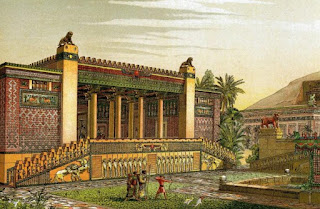
Atmosphere: Old money and old power, political intrigue, massive inequality. Looming stone structures a la Persepolis.
Size: ~9k souls.
Demographics: Mostly Shahanistani, small frogling and weirdwalker minorities.
Ruler: Satrap Gholam Ruyanian
Major Cults: Cult of the Morning Star (sanctioned), Cult of Mitra (sanctioned), Cult of the North Star (sanctioned), Followers of the Veiled One (banned)
Major Factions: House Taburi, House Manati, The Temple Reformers, The Snakes, The Mongeese, The City Guards
Landmarks: Hangman Bridge (river crossing, public executions), Lion Bazaar (major market), The Plaza of the Horse (horse racing and gambling), The Iron Pit (prison and city guards).
Quarters: The Tigerskin Quarter (froglings, weirdwalkers, and industry), The Charcoal Quarter (the poor, destitute, and craftsmen), The Bay of Red-Feathered Plenty (noble shops and homes of House Manati), the Emerald Eye of the Basilisk (fighting rings, homes of House Taburi).

What one of the gates to the city might look like (the Ark of Bukhara in Uzbekistan)

Short Descriptions of Factions
House Taburi is a well established noble family centered on the city of Tabur, but with land holdings and dehqans of many ages spread primarily throughout Elburz satrapy. It is the family of Farzaneh Taburi, the group patron, and thus House Taburi is the faction that the players are most associated with.
House Manati is the greatest rival of the Taburis, although they are a younger house. While Taburi can draw their lineage back to some of the earliest shahs of Elburz, Manati claims descent from the Conquering King. The jockeying for power between Manati and Taburi is why the Shahanshah has appointed a third party as satrap of the province.
The temple reformers are a loose collection of priests and temple bureaucrats who believe that the enlightened temples have been taking advantage of the poor and needy and seek to reform the religion and, by extension, the state of affairs to better society. Many of them are followers of the Veiled One.
The Snakes and the Mongeese are the rival horse racing teams of Tabur, with followings in most of the cities of the north of the Enlightened Empire. Think something comparable to the Blues and Greens of Justinian's Constantinople, along with their gangs of supporters.
The City Guards are the clenched fist of Satrap Ruyanian, although they are mostly centered on the edges of the city and at the Iron Pit where criminals and heretics are held and executed.


The Tigerskin Quarter
Sights: Closely packed brick houses, tight winding streets, frog lords in water tubs carried on the backs of slaves.
Sounds: Conversations in several different languages, braying of beasts, croaking of frogs, clanging of metal on metal.
Smells: Burning smoke in the air, brackish blackened water, wet clay, hot metal.

The Steel Serpent:
The official supplier of metal arms and armors for both the city guards and the forces of the Kanarang whenever he comes to Tabur. The only official source of plate armor and other such items in the city, and to even be able to purchase such items requires bribes and cajoling.
Mail Armor: 150 drachmae
Cataphract Armor: 500 drachmae
Grivpanvar Armor: 1,000 drachmae
Cataphract Horse Armor: 1,000 drachmae
Grivpanvar Horse Armor: 1,500 drachmae
Repairs to any set of armor: Half the listed price i.e. 250 for repairing cataphract armor, 500 for repairing grivpanvar armor.
Short Sword: (such as akinakes) 12 drachmae
Two Handed Sword: 25 drachmae
The Steel Serpent is the only place where one is able to legally acquire a sword in Tabur and, as mentioned above, access is controlled.
Etc.

The Tigerskin Quarter is home to Tabur’s two minority communities: the froglings, sorcery-wielding amphibians from the marshy land surrounding the First City in the western regions of the Enlightened Empire, and the weirdwalkers, an exiled people with no land who are on a journey in search of their lost god (Kusa’s people!). The froglings cheer for the Mongeese.

Potter's Alley:
This is the place to go if you need any kind of ceramic ware or glass (it has been since days long gone that glassblowers were lumped together with potters), and so it is frequented by anyone in need of a container for anything else. Potter's Alley is also on the edge of the neighborhood of the weirdwalkers, their mysterious kilns belching sweet smelling smoke up into the sky.
For a typical clay vessel, price varies by who is making it and by size. Typical size to price ratios are:
Very Small: can fit roughly one swig of a liquid or a small amount of solid, 2 drachmae
Small: a small bowl or oil lamp size, 3 drachmae
Medium: comparable to a water bottle or larger bowl, 5 drachmae
Large: an amphora of wine or something of comparable size, 9 drachmae
Very Large: a very large bowl too large to hold in one hand or even both hands, 15 drachmae
For glass vessels, add 5, so very small becomes 7 drachmae, small 8, medium 10, large 19, very large 25.
It is possible to commission weirdwalkers to make ceramics with mysterious properties, for that is the gift of their crawling god. Such creations have their prices determined on a case by case basis.

Random Encounters in the Tigerskin Quarter (1d6):
1: A contingent of burly sooty slaves dragging a hot crucible through the winding streets, holding onto it with heat-resistant gloves and tongs and dragging it on dirty clothes. They are singing working songs and swearing up a storm.
2: A panicked debtor is attempting to pawn off subpar blades that they say they were convinced to sell by a frogling blacksmith. If they don’t get money for the blades, they’ll be sent to the Iron Pit!
3: A frogling mother has accidentally dropped the clay jar she was using to carry around her tadpoles!
4: A group of weirdwalker children playing in the street with clay toys of different animals and monsters. If you didn't know better, you'd think some of them were moving on their own!
5: A hunched over manservant dragging a cart behind him is in the process of picking up and taking back swords and other weapons for the city guards. He is dissatisfied but afraid of punishment.
6: A frogling coin lord is being marched through the street in a tub of sloshing water borne on the backs of four slaves. They are going around the streets in some fusion of a business trip and a flaunting of wealth.


The Charcoal Quarter
Sights: Tenements housing many more families than can comfortably fit all stacked one upon the other, crumbling ruins as the quarter gets closer to the city walls, beggars and carpenters and dye workers.
Sounds: Plaintive groans, feet padding upon the wet ground, arguments in some house you can't quite see.
Smells: Water, sweat, smoke from wood fires to make charcoal.

The Charcoal Quarter is where most people in Tabur live. It is presumably where most of the players have been staying when not going on adventures for Farzaneh Taburi, at least just due to it being the cheapest place to live. It is also a good source of rumors, namely from everyday lower class inhabitants of the city; most of the rumors that the players have received have come from NPCs centered in the Charcoal Quarter.

In addition to being the population center of the city and the poorest section of the city, the Charcoal Quarter is also where most craftsmen are centered. While those who work in industries that require a more forceful and fiery hand, such as blacksmiths and glassblowers, dwell in the Tigerskin Quarter, simple carpenters, bakers, coopers, dyers, candlemakers, and others in similar professions work here. Probably the biggest landmark of the quarter is the great dye works, where swarms of barefooted young women and men with bright stains up to their knees provide color to the spun cloth of the town.

Notably also, the Charcoal Quarter is where one can find most hirelings on the cheap. Drachm Street, where beggars and those in need of odd job employment aggregate, is where many such people can be found.
Example hirelings of Drachm Street:
Beggar: 1 drachm, +1 hit point
Light Bearer Boy: 1 drachm
Failed Stonemason: 3 drachmae, skilled at digging and cutting stone
Dye Works Girl: 3 drachmae, agile and quick, able to identify liquids
Tough Bully: 4 drachmae, +1 to hit and damage
etc.

Random Encounters in the Charcoal Quarter (1d6):
1: A millenarian street preacher, clad in garishly colored robes and with some implement of pain wrapped around their necks and arms. They call for all who listen to heed their warning of the coming prophet. If they linger too long, they will be arrested by the city guards.
2: An elderly beggar, a veteran of a battle against the Gnostic Elves decades upon decades ago, holding out a bowl for alms as he sits on the corner, unable to move except on a little wooden cart made for him.
3: The loud sound of an energetic youth harking goods outside of a family shop. They are making these little pieces of carpentry sound irresistible. 
4: A scrap in the street! 2d4 youths (and perhaps their tired and haggard parents) are caught in a fist fight over some perceived or real slight. The only way to find out is to intervene.
5: A gaggle of dye girls striding through the murky street, their legs and arms stained a cacophony of colors. They seem very excited to go see something.
6: A giant insect, pitch black from the choking smoke, crawls on the wall beside the group. It can spray a noxious fluid from its behind, and tastes foul raw but delicious when boiled (though make sure to throw away the water after, it'll be choked with coal dust)


The Bay of Red-Feathered Plenty
Sights: Houses made of beautiful wood and smooth stone nicely spaced from one another, bright red feathered plumes that loom over the street, servants in well to do garb anxiously going from store to store.
Sounds: Jovial conversation filled with words that you only half understand, deep guttural laughter, discussions over prices, water and wine being poured from clay jugs.
Smells: Spices, wine, olive oil, and aromatic woods. The dried out skin of long dead animals and dusty feathers.

The heart of upper class artisans and craftsmen, who work in fineries and fripperies day in and day out. Just about the only place here in the east where the traditional luxuries can be easily bought and sold (other than, of course, Humakuyun on the sea, but that city has many more unorthodox luxuries as well). The ancient arts and poetries of the region are represented well in this district. Additionally, the Bay of Red-Feathered Plenty is the center for House Manati, whose scions and princes dot the rolling riverside hills of the district in spades. It is beside the river itself where the most ancient building in the quarter sits, the palatial estate of the Conquering King's bastard son's descendants, the heads of House Manati. While House Manati presides here, they cannot stop the nobles of House Taburi from venturing in; but the Manatis have made as much of an effort as possible to keep their district as autonomous as possible from the sway of the city guards.

While it is technically not illegal to set foot in the bay as a member of the lower classes, being visibly poor will result in disgusted glances and refusal of service. If you dress in clothes befitting a higher station than your own, then perhaps you can get by in the wide boulevards of the bay, but being found out as a facsimile of the rich will net you an even worse punishment than simply being poor in the district. Alternatively, you can simply spend Rapport with your patron to have her accompany you in the bay, resulting in everyone assuming you are simply one of her clients or slaves.

The bay gets its name from the red feather plumes that loom over it during the day, and from the crimson Parrot-Fiends who haunt it at night, squawking loudly and entrapping trespassers in an unbreakable embrace until guards arrive (although in certain situations this is actually until pigmen in the service of one of the noble scions of House Manati arrive; in fact, the bay has a sort of parallel system of pigmen guards for affairs internal to House Manati). The parrot-fiends are sorcerous undead creations, and can be turned by clerics. The city guards hate them.


Example stores in the Bay of Red-Feathered Plenty:
The Aviary of Ashfar Ghen - Large building filled with cages of the finest and most exotic birds. Exorbitant fees must be paid for long distance transportation without the birds eaten by tigers. 
The Herpetorium of Yamsheen the Wise - An unassuming building operated by an old woman from a long line of fine lizard breeders. Illegal gecko production facility in basement, shipments sent to the assassins in Humakuyun.
The Manticore’s Tongue - A warehouse of spices, owner on good terms with Farzaneh Taburi. Locked up tight at night for fear of robbery, even with the bay’s security system.
The Silver Scale - A rather new lizard breeding enterprise established by a brineman named Farfeen. Closely involved in parrot-ghoul maintenance.
Sarai’s Silken Thigh - A purveyor of fine clothes, which supplies the city’s nobility with fine silken brocades and dyed cloth. Sarai owns a dying facility in the Charcoal Quarter.
Order of the Red Feather Dancers - A dancing company that takes in young men and women and turns them into dancers and confidants. Also sells spy-monkeys.
The Glinting Knife - A secret weapon supply for the nobility and merchants. Specializes in the production of blades for quick and silent murder. 
Yaghbona’s Furs and Skins - A purveyor of fine clothes, but more particularly focused on items made of animal furs and reptilian scales. One of the few shops in the bay regularly visited by adventurers.

Random Encounters in the Bay of Red-Feathered Plenty (1d6):
1: A foppish young nobleman being borne along on a palanquin, sightseeing around the quarter that he already lives in. He is loose with his coin, and easy to fool.
2: A poor river fisher on their boat, being yelled at by a port servant in dark robes for stopping in the bay's wharf.
3: A mysterious palanquin with its curtains drawn in close, only vague silhouettes visible through the thick brocades in the midday sun. Rumors abound as to what is in it; a portion of a noble's harem, a fine treasure being transported from house to house, perhaps even an eccentric noble themself?
4: An artist displaying lizard poetry in the street. The beautiful words encoded in the patterns of scales on the reptiles' backs are mesmerizing.
5: A group of burly men in full body cloaks and masks march through the street, carrying bags laden with fineries upon their backs.
6: A wandering, meandering party of nobles and their hangers-on crawl through the street, wine drunk and with full stomachs.


The Emerald Eye of the Basilisk
Sights: Houses of ancient stone hewn with the finest of tools, tall buildings painted in bright hues of green, mercenaries and guardsmen for hire lingering on certain corners, members of house Taburi striding in the street with parasols held above them by manservants.
Sounds: Whispered conversations at street corners, the wind flowing through silken curtains, the muffled sound of fighting somewhere not too far away and not too close.
Smells: Incense, soap, blood. The fresh smells of the river as it flows into the city.

The Emerald Eye is the old center of the city, the part of town that has been inhabited for centuries before even the time of the Conquering King. The crumbled remains of the city's original stone walls encircle this district, as the city has grown far past its meager beginnings innumerable generations ago. At the middle of the Emerald Eye is a hill, where in ancient days it was said a basilisk was born on the night of a viridian comet and a full moon. That baleful rumor kept the pastoralists of the valley away from the hill and away from the river it sits beside, allowing for a settlement to take root. Sitting atop the hill is the palatial abode of the city's satrap, Gholam Ruyanian; at its foot is the Iron Pit, the dreadful jail where criminals and heretics go to die. Encircling the satrap's palace are the homes of House Taburi, the ancient family who founded this city.

While House Taburi are the ancient founders of the city, they are also deeply involved in the trade networks that pass through the valley, and in many of the affairs that this implies. The Taburis have a finger in every pot, so to speak; Farzaneh, for instance, is deeply involved in the salt and spice trade through the Great Desert to the south. As a result, there are many warehouses owned by House Taburi in this part of town. One of the more unsavory businesses which House Taburi have gotten themselves involved in is the mercenary trade. While there are independent mercenary companies in Elburz satrapy, House Taburi dominates this area in Tabur proper. This, however, was made difficult by the ban on open carrying of weapons in the city put in place in the not too distant past. As a result, there are those in House Tabur who operate secret fighting arenas and underground training facilities, trying to stay under the nose of the city guards, or bribing them every once in a while.

Example mercenaries and hirelings of the Emerald Eye district:
Great Desert Slingman: 7 drachmae, wields a sling
Desert Guide: 9 drachmae
Dog Headed Mercenary: 6 drachmae as long as you let him eat what he kills, wields a nasty weapon
Spearman: 8 drachmae, wields a spear
Caravan Guard: 7 drachmae
Amazon Guide: 12 drachmae, wields bow at +1
Wrestler: 10 drachmae, skilled martial artist and can perform feats of strength, carries a training club
etc.

Random Encounters in the Emerald Eye of the Basilisk (1d6):
1: A gaggle of temple bureaucrats and palace scribes striding through the street, deep in conversation about taxes and financial minutiae. Their pockets are weighed down.
2: A wrestler in traditional garb practicing in the street with large weighted clubs. His brow glistens with sweat and his hairy chest heaves up and down.
3: A lithe hunting dog on the loose, its leash still clinging to its neck. This is obviously the pet of some nobleman, but the thing will resist capture.
4: A meeting of functionaries for some business of House Tabur's, discussing prices and trade routes and hazards along the way. Maybe they'd be open to an offer of help?
5: A group of mercenaries attempting to advertise their skills and prowess without direct reference. Spearmen wielding errant branches, wannabe cataphracts on donkeys. They know a guard is nearby.
6: A young member of house Tabur striding through the street in ostentatious dress and style, their long cloak held up off the ground by two manservants behind. An older woman, presumably the noble scion's mother, stands at a distance, disapprovingly.


That's all I wanna share about the city for now! Obviously there are more opportunities for tables or descriptions of NPCs or things to do with the landmarks I mention at the top of the page, but this post is long enough as it is so that will be for a different time.

Tuesday, June 8, 2021

King of Kings Session 7 After Action Report

 King of Kings has RETURNED, or well it returned a few days ago, the session was last Friday. But I've been rather busy since then with Things and haven't had time to write up a session report for it.

Dramatis Personae
Ishthyromeda the Small, level one amazon
Kusa, level one cleric of the exiled and half-dead foreign goddess Nasitu-Neb
Manchugo Coldeswain, level one cleric dedicated to Damir, foreign god of the trade routes
Rohm'Daan, level one cleric dedicated to Anzhalar, a local chthonic god of subterranean flame
Zana the Charlatan, level one magic-user

To begin with, treasure from the previous session was handled, resulting in 85 drachmae being given to each of the five players present (technically a bit wonky since most of these players weren't at the previous session but it all evens out in the end). Clerics receive 76 after the tithe was taken off. BUT after Housekeeping from the unresolved session from months back was handled, things actually got started in earnest.

It was a fine and sunny day, and a holy day at that! The festival of Jumhura, the Rebel Saint, He Who Broke Spears on His Knee, He Who Spoke with the Voice of the Sun was here! The whole of Tabur was abuzz, and the five adventurers decided to make way to Temple Town for the festival. Shortly before leaving, however, Kusa went to the group's patron Farzaneh Taburi to hand over the clay lamp in the shape of a huma bird that she began work on some time before. The group decided to take a less direct route, leaving via the northern gate of the city and traveling on a wilderness road, astride their horse-drawn cart.

On the road, however, they came across a horrid figure... Jamshid, the mercantile rival of Zana from his previous life as a less than successful merchant. The muscular black-bearded man seemed to be visiting Temple Town to take advantage of all of the captive customers during the festival. Immediately, Manchugo and Zana started yelling at him, and a shouting match ensued where Jamshid mocked them and made only small shifts out of the way of the cart. The loud yelling attracted a group of goatherds, who at first were concerned but very quickly took to resting on their staves to watch the situation go down. Ishthyromeda rode up ahead and attempted to push at Jamshid's cart with her javalin, but he budged only slightly. The group considered ramming his cart to push him off the road, but didn't act on it. Kusa ran up ahead and asked for a ride on Jamshid's cart, which Jamshid gave... and then Kusa turned to look at her friends' cart behind her, showing off her firestarter in her hand. For the sole reason of Zana's backstory rivalry, they collectively decided to just make this the worst day for Jamshid.

In short time, the two carts both reach their destination: Temple Town, more properly called the Hallowed Halls of the Holy Mountain, the ritual epicenter for Elburz satrapy and the headquarters of the temple bureaucracy for the whole of the east. The wide plaza of Temple Town was teeming with the raucous crowd, and just as the group arrived the mummified corpse of Saint Jumhura, curled up with his bony legs drawn up to his chest, was borne out of the fire temple at the center of the ritual plaza to be taken up to the cliffs where the mummies of the eastern saints reside... And at the same time, Kusa set fire to Jamshid's cart and quickly dashed away into the crowd. From this point on, the group somewhat split up: Kusa, Manchugo, and Rohm'Daan dashed over to the market-temple of Damir in Temple Town, while Ishthyromeda haggled in the crowd and Zana focused on his rival's fire.

Their messing about with Jamshid prompted a lot of memes to be made... this is only one of them!

Zana (and Kusa somewhat): As the fire grew and blazed ever-larger, more and more of the people in the crowd noticed and began to panic, and the guards posted at the gates to Temple Town's mausoleum-laden depths dashed over to attempt to put out the fire. For setting the fire, Kusa received 20 XP. Zana stood by and watched as the fire raged, and when it began to dwindle down, he stepped over and helped put out its last remaining embers, turning to mock his rival as he sat on the ground staring fearfully at the ashen remains of his cart. For mocking his rival and putting out the fire, Zana received 20 XP.

Ishthyromeda: Ish haggled with a sacrifice-seller in the crowd to buy a goat from him, and did so for only 8 drachmae!

Kusa, Manchugo, and Rohm'Daan: Visited the market-temple of Damir, which is operated by the former master conman turned... well, he's still a conman, but now its part of his official job, Mansour Jir. He is a young man with a short cropped black beard, and almost immediately took to selling trinkets to the trio. Rohm'Daan bought a tooth of Saint Melcayak, the blind and de-fanged dogman saint, while Manchugo sat in awe of Mansour's fame as a conman-merchant, and then began to explain the importance of mercantile activity to Kusa and sold a small basalt idol of the Conquering King to her.

After all of the above, the crowd had dissipated and the group decided it was time to bring the day to a close. Rather than making the journey back to Tabur, they decided to rest in one of the two pilgrims' houses in Temple Town, marching over to the Snail's Trail. Within, they found a small dining area with a wide clinic-hospital off to the side where groaning men and women could be seen on low-lying beds. There was a counter toward the back of the entrance hall, with a large snail's shell resting atop it and a woman in a thin purple veil and green robes standing behind it. Kusa, Manchugo, Rohm'Daan, and Zana each bought a room for the night (for 12 drachmae each), while Ishthyromeda slept on the cart with her newly bought goat and her horses.