Showing posts with label biology. Show all posts

Wednesday, May 22, 2024

The Short-Legged Man-Mimic Lizard

A friend and coworker of mine gave me an old drawing tablet she no longer uses, as a gift. I haven't used drawing tablets all that much, mostly because when I was younger I just sorta bounced off of the only one I had ever attempted to use, not quite able to wrap my head around drawing without looking at my hand holding the pen. This time, it has come much easier to me; I guess I just needed time to grow and improve or whatever. Anyway, here's a monster I drew (in MSPaint) with that drawing tablet the day I was given it.

Short-Legged Man-Mimic Lizard
Number Encountered: 1d3
Hit Dice: 1
Attacks: 2 claw (1d4) + 1 bite (1d6)
Armor: as leather + shield
Morale: 6
False Face: The short-legged man-mimic lizard sports a false human face on the underside of its neck, which, in low-light conditions, vaguely resembles a real human face. Human beings will recognize that it isn't a person, but non-humans and animals may be tricked by it.
Mating Display: Male short-legged man-mimic lizards create elaborate, almost sculptural, structures to entice females during their mating season; these often incorporate large collections of pearls collected from the insides of their prey, deliberately placed in pillars of dried lizard waste and mud. These courtship structures will contain 3d6 pearls worth 2d4*5 gold [or silver if using a silver standard] each.
Toe Pads: The short-legged man-mimic lizard has subtly hooked scaly pads on the underside of its feet, allowing it to climb walls and ceilings.

A true result of the intertwined ecosystems in subterranean dungeons, the short-legged man-mimic lizard is an active, skittering predator that prowls dimly lit halls and cavern tunnels in search of its prey. Its method of hunting: subterfuge. These reptiles feature an uncanny imitation of a human face on the pale green underside their necks, complete with bumps that resemble a nose, ears, and the folds of the cheeks and brows, a crescent moon of scarlet a la lipsticked lips, and large orange and white eyespots that, in low light conditions, would look like a human's eyes, wide in shock, to any dumb beast of the underground. One might assume the man-mimic lizard uses this facsimile to ensnare human prey, but this couldn't be further from the truth: the short-legged man-mimic lizard isn't a man-eater, but an eater of man-eaters!

Dungeons are full of monsters that have taken a liking to the taste of human flesh, namely soft-bodied invertebrates and cartilaginous creatures like Ropers, Trappers, Lurkers Above, and Cloakers. Coming upon one such man-eater, the man-mimic rears its neck, inflates the red wattles so that they sway about like hair in nonexistent wind, and positions itself right in front of its quarry's beady little eyes. When the Roper ensnares it in its tentacles or the Trapper curls its stiff body around the lizard, the man-mimic begins its vicious struggle, its needle teeth and razor claws slicing through mollusc and cave-ray flesh like butter. While sometimes the man-eater wins out, most often the man-mimic lizard leaves with a belly full of slimy flesh and its prey's green ichor blood strewn all across the dungeon floor.

Adventurers have nothing to fear from short-legged man-mimic lizards; they generally (unless under the influence of a spell or disease that addles the mind) do not engage with human or demihuman interlopers, and tend to avoid adventuring parties. The man-mimicry won't work half as well if there's real humans right next to them! They will attempt some resistance if, during their mating season, adventurers attempt to pilfer their courtship structures. Embedded in the guano and mud daub pillars of their elaborate courtship nests are pearls, little marbles of glimmering white, torn from the gullets of Ropers and Lurkers Above; these can be valuable collections for enterprising dungeon delvers. If these dungeon-pearls are large enough, they can fetch high prices from jewellers and collectors up top!

Monday, August 29, 2022

Pygmy Giants

Drawn by yours truly

Pygmy Giant
Number Encountered: 1d8 (5d8)
Hit Dice: 3
Attacks: 1 weapon
Armor: as leather
Morale: 8
Bullied Followers: Pygmy giants are often bullied or otherwise forced into submission by other giants and sometimes the few humans who come by their islands, and will often be found in the service of giants and sometimes in the crews of sailors and pirates.
Herding and Fishing: Pygmy giants are avid herdsmen and fishermen; they will react violently if their herds or nets are disturbed.
Weapons: Wield clubs, stones, and spears.

Pygmy giants are children of 'Ajuj and Majuj, the monstrous pair of the far north, the twin fathers of monsters, beasts, and giants... but unlike 'Ajuj and Majuj's other children, they are much, much smaller. Having been confined to isolated islands in the Sea of Giants, or distant frigid crags on the always frozen sea far to the north, they have undergone insular dwarfism, shrinking down to just under the average size of a human. They are just as muscular and dense as true giants, however, packing a lot of punch in a rather small package. Their heavily plodding feet leave deep furrows and prints in the wet sand of their salty islands, as they herd beasts of burden and fish from the depths. However, sometimes pygmy giants are pressed into service for their larger brothers and sisters, sometimes especially callous giants depopulating whole islands of their pygmy giant inhabitants for some raiding campaign thousands of miles away. The pygmy giants are xenophobic and wary of outsiders, and resentful of their elder brothers and sisters, but size and might makes right in the terrible family of 'Ajuj and Majuj.

Pygmy giants in the northern reaches of the Land of Darkness tend to be furrier and woolier than their more southerly cousins, but there isn't a hard divide of pygmy giants into two groups, and they can be just as visually diverse as other giants.

I just really love including real world biological concepts in my games and in my settings, and insular dwarfism is such a fun phenomenon! I also just love the image of little squat giants fending off adventurers trying to land on their island, or using these little guys as go to humanoid opponents in scenarios involving giants. Thinking up adventure locations using them as we speak!

1d12 Herds of the Pygmy Giants
1. Sheep
2. Walruses
3. Land octopuses
4. Cows
5. Coconut crabs
6. Giant (or normal sized) snails
7. Goats
8. Sturgeon (herded in water for their caviar)
9. Dogs
10. Pygmy wooly mammoths
11. Pygmy wooly rhinoceroses
12. Ostriches

1d12 Pygmy Giant encounter activities (home islands)
1. Spearfishing in the craggy shoals, the salty waves licking at their ankles.
2. Roasting a herd animal whole over a fire, filling the air with jokes and booming laughter.
3. Cooking one of those comically large cauldrons, or possibly a clay vessel, full of boiling broth over a fire.
4. Reciting poetry to one another in their gravelly deep voices.
5. Goading on a pair of crabs to fight each other.
6. Crushing seashells between two stones to create pigment.
7. Absentmindedly staring out over their herd, leaning on a club or crook.
8. Squeezing a very stressed looking sturgeon to push out its caviar directly into their mouths.
9. Painting an elaborate scene of dolphins and flying fish on a cliff face.
10. Curing beast skin into leather on a rack of driftwood.
11. Wrestling each other in a dusty circle on the ground.
12. Butchering a herd animal into pieces, and attempting to glean prophecies from its guts.

1d12 Pygmy Giant encounter activities (elsewhere)
1. Being beaten with a whip by a giant general.
2. Getting in a fistfight with one another, with brass knuckles made from seashells.
3. Getting their teeth pulled out.
4. Riding on wooly rhinos, two or three pygmy giants to a beast.
5. Practicing combat maneuvers in a field.
6. Roving the countryside harvesting branches to make wicker shields and arrows.
7. Rolling a boulder through the valley to bring to their giant master.
8. Hunting birds with spears and slings.
9. Groaning in pain, recovering from injuries.
10. Carrying armfuls of eggs in a panic, chased by angry chickens and/or peasants.
11. Sharpening their tusks to razor sharp points.
12. Playing games of dice carved from sheep bones, betting on meager pieces of fish and mutton.

Sunday, July 31, 2022

King of Kings Session 14 After Action Report

A bit of a shorter one! Not as much happened this session, so it mostly ended up as a sort of information gathering session. Also, this sesh happened like half a month ago, July 17th; I kept on putting off writing the post. My bad!

Dramatis Personae
Ishthyromeda the Small, level one Amazon
Manchugo Coldeswain, level one cleric dedicated to Damir, foreign god of the trade routes
She-That-Is-Harrowed-By-Our-Lord-In-The-Stars-Is-Blessed-With-Prophecy, level one scholar
also Parsani, scrawny son of a rural matriarch

(Note: She-That-Is-Harrowed-By-Our-Lord-In-The-Stars-Is-Blessed-With-Prophecy will be referred to as "Harrowed" for the remainder of this report and also probably for all future session reports)

The day previous, the group used a charm spell to get information out of the nasnas in the basement and to let them know that they wouldn't harm them. After making camp, they rested there in the walled farming compound. In the morning, the group realizes that they have been robbed! Manchugo having lost some rope and Ish having lost some food. After breakfast, Rohm'Daan had to depart for religious obligations back in Tabur (i.e. his player couldn't make it), and while the day's plans were being discussed Coro the Esoterian, tired and old, agreed to watch the group's supplies above ground while the rest of them ventured down below (i.e. his player also couldn't make it). Passing Rohm'Daan on the road back to Tabur, however, was a foreigner who had recently made contact with Farzaneh Taburi, and who had heard talk of the group's expedition. This was Harrowed, a scholar from a far off land with an affinity for insects, who joined the group for the day's venture back into the abandoned basement.

(Note: I had the players choose what got stolen in the night, and since Rohm'Daan and Coro's players weren't present for the session they didn't get to pick. I'll just bring it up next time they join.)

Western Caspian Turtle (Mauremys caspica)

After introductions were exchanged between Harrowed, Ish, Manchugo, and Parsani, the four set about finishing up where they left off the day previous. First, they went back to the outhouse where they heard a mysterious hissing yesterday, and opened the door to find... a very large turtle, its legs splayed out on the outhouse seat, hissing at the interlopers! They pick the turt up and gently place them down in the overgrown vegetable garden, although they agreed to pick him back up before they left to go back to Tabur.

After the small encounter with the outhouse turtle, the small group of adventurers went back down into the basement to enlarge the ant hole that they went through previously, so it would work better as a potential escape route or for repeated visits. Using some rusted shovels found leaning on the wall of the house outside, they set to work and make it large enough for someone to walk through, rather than having to crawl on hands and feet like before. They notice, as they work, that there are no sounds of the nasnases in the other room, and when they check the room before venturing further they notice that the creatures are gone!

Their work attracts a large group of the giant ants who live in a network of tunnels connected to the basement. Ish is cautious around the ants, and while she wants to explore the ants' tunnels she doesn't wish to anger them. Harrowed, after the digging at the hole is done, goes to the giant ants that have crowded around them and attempts to speak with them. Harrowed's monastic sect has a careful and considered relationship with insects, and so by relying on bodily communication a very simple sort of back and forth can be established, although it takes time. (Note: I just ruled that this bug communication works the same as a normal scholar class specialization, which you can see described here. It took basically an hour for Harrowed and the ant to have what would between two humans be only a few short sentences exchanged back and forth). 

While Harrowed attempts to make contact with the ants, the others take a break to eat some of their rations, and then one turn later they hear some snuffling sounds from the sloping passageway into the basement they entered through. Slowly moving back to check on it, Manchugo sees a pair of oversized weasels, which the group decide not to engage with.

After Harrowed's hour of focus, they report that the giant ants will allow the group to go straight through their tunnels and to a carved out passageway on the other end of their nest, a passageway that they dread, but that they are not allowed to enter any other chambers of the ant nest. The group agrees, and gently crawls into the giant ant's nest, as guests passing through. They crawl through one empty chamber dug out of the earth, then through a second round chamber that has on its southern edge a sloping tunnel carved out of the earth by tools not by ant mandibles, immediately apparent that something else dug it out, not the ants. In that chamber, they also find, hidden under a small pile of loose dirt, ten drachmae and a crystal syringe full of a strange green liquid. After pocketing the coins and the syringe, they venture into the dark dug out passageway that the ants dread.

After a lengthy march down the sloping passage, the four of them end up in a strange immense structure that none of them recognize. It is a massive open space, completely dark except for the minuscule spheres of light from their lamps, with a walkway that curves past them and out of view. This walkway seems to spiral around the edge of an immense cylinder, so large that they can't even clearly see the other side from where they stand, and they can only just make out the vaunted, curved ceiling high above them when they lift their lanterns up high. Above them is a stony dome shimmering with slime and dripping water, the walls similarly covered with green algae and slowly dripping slime. In this ancient structure, these adventurers are deeper in the earth than they have ever been before.

They realize that this place is likely That Which Yawns Deep which they heard in prophecy, and agree not to spend too long down here with such a small group. They plan to scout a little and then return to Tabur, to come back with a larger group. With that plan in mind, they send Parsani back to the surface; they don't want to have to tell his mother that he died in this dark and dingy place. They begin to crawl down the slowly sloping spiraling walkway, careful with their footing so as to not fall into the unknown depths below.
A giant slug by Tony DiTerlizzi!

Up ahead, they make out a scraping noise that catches their attention. Weapons at the ready and slowly inching forward, a vague lumpy shape takes form on the edge of their lantern light, slowly coming into focus as they get closer and see... a giant slug! It is larger than any of the adventurers, and is adhered to the wall and walkway at a right angle, scraping algae off the wall with its rough radula. After some discussion, they decide to just not mess with it and to not bother trying to climb over it, and so turn around and go back up to the surface.

The classic giant slug from the AD&D Monster Manual!

Grouping back up with Coro and Parsani on the surface, they set out for Tabur. Just outside Tabur, they run into a group of noblemen and their hangers on who are playing a game of polo out in the rolling hills of the valley. Manchugo strikes up a small conversation with one of them, who takes kindly to his polo advice and throws him a golden denar as a gift. Passing through the northern gate into the Tigerskin District, they get by with only an inspection of their goods. When they report to Farzaneh, she is very glad to hear the news of Parsani's family switching allegiances to her noble house, and is interested in the alien cylinder buried deep within the earth that the group discovered. And with that, the session drew to a close!

Treasure Acquired
10 drachmae
1 denar (worth 100 drachmae)
A crystal syringe filled with a strange green liquid

Non Treasure XP Acquired
50 each for discovering That Which Yawns Deep
10 for Harrowed for successfully making contact with ants

Saturday, April 30, 2022

Elden Ring's Land Squirts for Old School Roleplaying Games

(I actually started writing this post like a month ago but then I got busy n distracted, so I'm finishing it now and posting it!!! Oh, and I have a personal website now, so check that out!) 

So everyone has been talking about that Elden Ring game huh? It looks fantastic, amazing vibes, great open world, lots of opportunities for adventure, the whole nine yards, but uh, I actually can't play it. Woops! My computer wouldn't be able to run the dang thing, so I've been watching playthroughs of it to get a peek into that lovely little lands between that From Software gave to us. And while most people are talking about the bosses, how there's like a hundred of them, and I will admit Elden Ring's bosses do look fantastic, there is something else that has caught my attention...


THE LAND SQUIRT!!!!!!!

Yeah, maybe they're not the most important enemy encounter in the game, but I really love them. The land squirts are found along the shores of the starting area of the game, Limgrave, as well as in a few other watery areas. They gather in clusters and are basically immobile, their only real defense mechanism being releasing a cloud of poisonous liquid from ports on one side of their body. If they are themselves poisoned then they explode into a cloud of poisonous liquid that can poison the other squirts near them, triggering a chain reaction that can kill them all. And that's basically it; these aren't a very story important enemy, they aren't very active, they're basically just a hazard to deal with when traveling through swamps and coastal regions.

But what is so special about the land squirts is that this is the first time I have ever seen anything in any form of media that referenced the sea squirt, one of the most fascinatingly weird animals, and a group of animals that I love. 
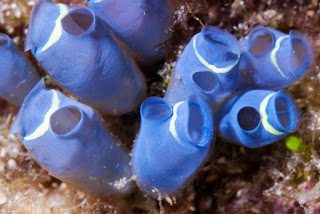

Sea squirts, or more accurately ascidians, are a type of tunicate that live in relatively shallow seawater. Tunicates are super fascinating animals, both for their sessile, filter feeding lifestyle, and because they are actually chordates! Yeah, the lumpy, eyeless, boneless, multicolored creatures you see before you are closer relatives to you and me than an octopus or a beetle, despite the latter two sharing more superficially similar structures with us! Tunicates are the only invertebrate chordates, meaning that despite the presence of a notochord (the structure that forms the spine in vertebrates), they lack a bony spine or any bony skeleton at all. In fact, when they are adults, sea squirts and other tunicates even lack the very notochord that defines the phylum Chordata! They have a distinct nervous notochord in their larval form (seen below), but when they metamorphose into the adult stage of their lives they digest the notochord, leaving them without a central nervous system. Isn't that just so cool?? The closest boneless relatives of humans, frogs, lizards, birds, sharks, and fish DIGESTS its own nervous system to transition to adulthood. I just think that is sick as hell.
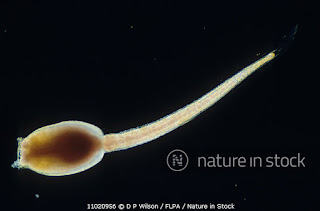
A larval sea squirt in all its flagellate glory!

Tunicates do this because they actually don't need a central nervous system as an adult. That's because sea squirts and other tunicates live lives where an energy-hungry brain would actually be somewhere between worthless and an actual detriment. To be precise, there are three types of life patterns that different species of sea squirts employ. On the one hand are the completely sessile solitary sea squirts that take root on the seafloor and filter out nutrients from the water; there is also a more socially organized form of sea squirt, where they are still sessile but form larger sea floor conglomerations, several squirts all rooting in more or less the same spot. And then, going in a completely different direction, are the much more mobile colonial sea squirts, considerably smaller than their sessile cousins, who form larger organism-esque colonies that can float and swim around the ocean, each individual squirt contributing to the whole. They're still filter feeders though, just ones that can move around. While I find colonial tunicates super cool and fascinating, the land squirts in Elden Ring are very obviously from the second type of sessile squirt, forming small communities rooted in close proximity to one another. Maybe a colonial tunicate monster would be a good opportunity for a post in the future?
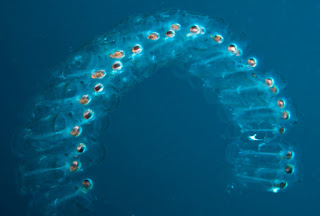
A super cool free floating colonial tunicate... not relevant to today's post, but very cool nonetheless!

Additionally, sea squirts in real life are actually not uncommonly used as food! And I don't just mean by animals, though of course the sessile sea squirt is a perfect prey item for many predators who don't really want to bother chasing something around the ocean (and, as an aside, the presence of tunicates on land has fascinating implications for what eats them). But it is also human food in many parts of the world! In Korea and Japan, for instance, a species of sea squirt known as sea pineapple (Halocynthia roretzi) is actually cultivated in captivity and served raw, sashimi-style, or as part of bibimbap! Sea figs or grooved sea squirts (Microcosmus sabatieri) are eaten in France, Italy, and Greece, served raw with lemon or as part of salads! In Chile, the piure (Pyura chilensis) is served as an ingredient in seafood soups! There's more examples of sea squirt based cuisine around the world, but I just wanted to share these as inspiration for potentially more creative applications of squirt based creatures in your elf games!
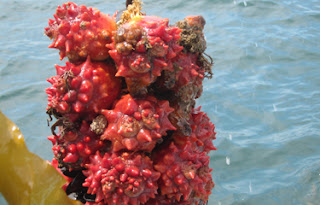
A bunch of wild sea pineapples all rooted in place!

Before I get into the actual game stats, there is one question that has to be asked regarding the very existence of the land squirt. In real life, sea squirts are filter feeders, they subsist on the floating particulates of the ocean, with orifices open for water currents to just flow through, almost like a sponge. Elden Ring's land squirts are, rather obviously, on land, where last I checked there weren't any ocean currents carrying nutrient particles (maybe small grains of dust or floating seeds caught on the wind?), but they still have the distinctive openings characteristic of real sea squirts. I don't really know how they eat! They still live in wet environments, swamps and on shallow coastlines, so perhaps they have openings that are lower to the ground to pick up food from the water? The openings on the top are where they release poison in-game, so maybe those are waste openings? The poison is also a bit out of nowhere since, rather obviously, real life sea squirts don't spit poison out of their orifices, but I don't care!!! I like the weird lumpy poison shooting swamp dwelling giant invertebrate chordates!!!

The "land squirt ashes" that let you summon spectral squirts in Elden Ring

Land Squirt
Number Encountered: 2d6+1
Hit Dice: 3
Attacks: poisonous liquid (see below)
Armor: as leather
Morale: N/A (they can't flee!)
Cluster: Land squirts gather together in closely packed clusters.
Poisonous Liquid: Land squirts can spew a toxic liquid from their anterior openings. Those in the spray's range and on the front of the land squirt must save or take 1d8 damage.
Sessile: Land squirts are completely immobile, rooted in place by a fleshy stalk. They are reliant on water to survive.
Toxic Overload: Despite being poisonous themselves, if they are poisoned they explode and release all of their toxins in a wide radius. Those within the radius take 2d6 damage. If there are any other land squirts within range, they are also poisoned and thus also explode.

I thought about trying to model their poison ability off of the Dark Souls/Elden Ring poison mechanic, but I think that may have to wait for another day. Also, because I think larval sea squirts are so cool and weird, here's a stat block for a larval land squirt despite those not appearing in game.

Larval Land Squirt
Number Encountered: 3d6+1
Hit Dice: 1-1
Attacks: bite (1d4)
Armor: none
Morale: 6
Self Digest: Larval land squirts can begin to digest their stiff notochord and other inner organs, typically three days after they hatch. Touching a larval land squirt while it is self digesting deals 1d6 damage due to the creature's acid.
Slippery: Larval land squirts are incredibly difficult to grab, and they will always slip out of attempts to grapple them.

Perhaps I exaggerated the metamorphosis process... well it's whatever, hyperbolic monstrous presentations of real life animals is what fantasy games are all about!

Also, since I think land squirts would fit super well in a Gamma World or GW esque game, here are stats for them for use with 1e and 2e Gamma World. I can very easily see myself putting them in the Great Black Swamp of my Gamma Ohio or on the shores of Lake Erie!


Land Squirt for GW 1e
No. Appearing: 2d6+1
Armor Class: 8
Movement: N/A
Hit Dice: 6
These swamp and coastal creatures are the gargantuan mutated descendants of sea squirts, filter feeding sessile invertebrates. They are reliant on water to survive, but the openings once used for filtering water now spew noxious poison. The poisonous liquid of a land squirt is a contact poison with a poison strength of 9. If a land squirt is poisoned, they will explode and release a large cloud of poison, and they can be poisoned by the poison of another land squirt. Land squirts cluster together in large sessile groups.

Land Squirt for GW 2e
Number: 2d6+1
Morale: N/A
Hit Dice: 6d6
Armor: 8
Speed: Does not move
MS: 1d4          IN: 1d4
DX: 1d4          CH: 1d4
CN: 1d12+9    PS: 1d12+6
Attacks: Poison spray
Mutations: Poison Susceptibility, Water Dependency
Description: See GW 1e description above.