Showing posts with label OD&D. Show all posts

Tuesday, June 21, 2022

Prehistoric War!!!

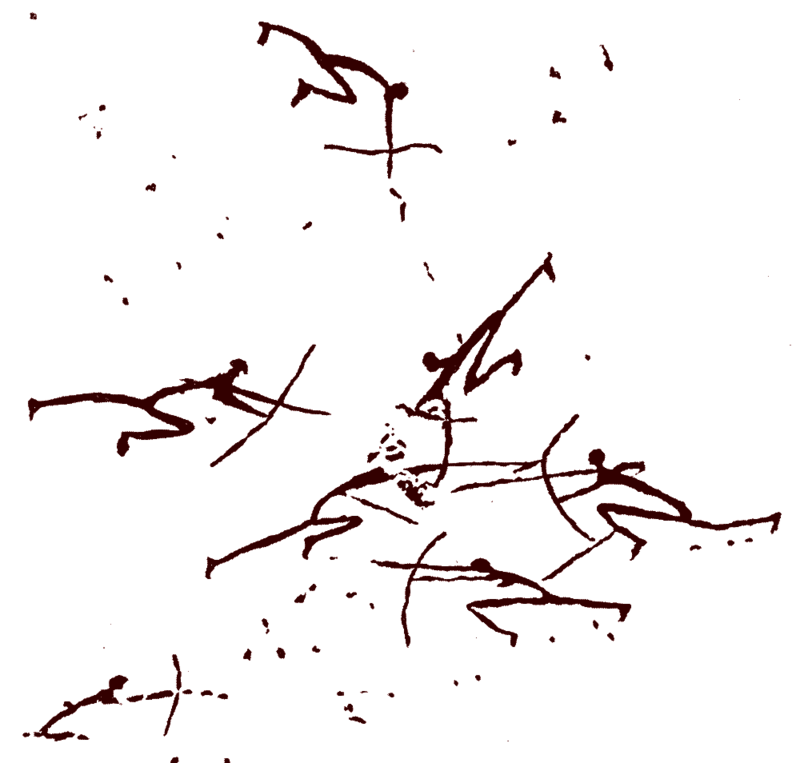
 Something that's been in the back of my mind for the past couple of days is making a combat system for a paleolithic/neolithic type game based on combat in the good ol' TSR war-game Chainmail. This has nothing to do with anything really, and in fact I have a bunch of other things I probably ought to be working on, but yknow this was on my mind so I had to bring it into the world. Maybe I could do some kind of Stone Age game at some point? Wouldn't wanna step on Pariah's toes too much!

So, the basics: the core of this is based on the Chainmail man to man table, but it also includes missile attacks and attacks and defenses from animals since I figure those would likely also be prominent in a Stone Age type game. Its a weapon vs. armor table, where the target number determined by the combination of the attacker's weapon and defender's armor is to be rolled equal to or over on 2d6. Could use it basically as a replacement for the d20 roll in the "Alternate Combat System", or using it straightforwardly with the Chainmail man to man system, do whatever really.

Chainmail also has a separate combat system for fantasy combats between fantastical/magical opponents, which I could totally see as an alternative to the modified man to man table I wrote up below. I prefer the idea of the modified man to man table though, because in the kind of culture that would exist in a late paleolithic/early neolithic environment things like weaponry would take more precedence than training or any kind of superhuman ability; no heroes or superheroes in the Stone Age! Perhaps some things could give a bonus, like having taken part in an empowering collective ritual? I don't know.

Putting the table in as an image because I don't think it would display right if I tried to squeeze it in the post as text

Since this is assuming the context of the Stone Age, specifically the late Paleolithic into the early neolithic (think the time around the building of Göbekli Tepe in what is now Turkey; I was actually writing this with early neolithic Anatolia in mind, or a more fantastical version at the very least), don't have to worry about horses, don't have to worry about metal armors, I also don't think have to consider shields much? I'm not aware of shields in the neolithic or paleolithic, if there are shields maybe they give a small bonus or something, like idk minus 1 to attacker roll or somesuch.


Instead, most armors are animal skins of different types, with the only entirely human made armors being textile and lamellar made from bone and wood. The different animal skins/hides/leathers on the table do double duty for both those actual animals in combat and humans wearing the skins of said animals. I just thought that that would be an interesting way to include animals and people in the same combat system while also communicating a type of shamanic or animistic element to the worldview of the people in the game. I was thinking of the practice of the berserkers in old Norse Scandinavia and of figurines like the Lowenmensch that combine human and animal features and the general preponderance of animals at places like Gobekli Tepe and Catalhoyuk. Maybe that could be expanded for specific types of animals, like wearing a lion skin gives you traits of a lion in combat, or it could be a bear, or a crocodile, or an ostrich, whatever.

Bird Skin: Primarily intended for flightless birds like ostriches and terror birds. Obviously none of those live around ancient Anatolia, but yknow I can include whatever prehistoric animals I want to include.

Some real fish leather armor, from Taiwan

Fish Leather: I think I'd use this for any aquatic creatures and for the skins thereof. Fish leather is a real thing you know! I don't think it would be very effective at stopping most things, but who knows. 

Thin Beast Hide: Originally I called this tier "Herbivore Hide", with the idea that herbivores are meeker, etc. Functionally, however, I think differentiating between thin vs thick is probably a better idea. Thin beast hides would be deer, antelopes, probably rabbit skins I bet, but also most carnivores such as lions.

Textile Armor: I feel like a lot of the time textile armor gets ignored! Textiles, quilted armor, and padded armor were much more common historically than leather armor was. I have no clue if textile armor was really used much in the neolithic, but I figure since people were able to make textiles by this point it isn't exactly impossible.

From the Cederberg Mountains, South Africa

Thick Beast Hide: Refer to thin beast hide, above. Elephants, hippopotamuses, rhinoceroses, oxen, I have no idea how thick their hide actually is compared to those but I feel like I'd put bears here too; they're pretty hardy animals!


Reptile Hide: Self explanatory. Again, no real prehistoric basis for this, but I do have a historic basis, in that reptile leather was used at times in certain ancient and medieval societies, like the ceremonial crocodile leather armor from Roman Egypt above. Also reptiles are a staple of prehistoric stuff.

A bone lamellar chest piece from prehistoric Russia, near Omsk

Bone/Wood Lamellar: Again, no real prehistoric basis, but all of the technology to make lamellar with materials like bone and wood were around so I just sorta assume that they had it. Lamellar, if you're not aware, is small plates of material, in this case bone or wood, together forming armor by being connected to one another.

Turtle Shell: Self explanatory.

Also I think the attacker weapons are mostly self explanatory. I included animal natural weaponry because I wanted to integrate animals and humans into the same combat system like I mention. I realized after writing the table that I didn't include anything for unnaturally large arthropods, which was an unfortunate omission! Big bugs are a staple of all tabletop roleplaying games, especially ones that I run; I think I would have them range from thick beast hide to turtle shell depending on the species, with either beak or crocodile bite for their attack again depending on species. What are mandibles if not a beak but sideways?

With carnivores and herbivores no longer divided, I was thinking that carnivores should get some sort of bonus. Perhaps extra attacks, or a penalty to the attacker's roll? I think that could work. This was partially suggested by a certain Gus L. Carnivores, no matter what type of hide they have, put a penalty of 1 or 2, depending on their size, to their opponent's roll. Terror birds get that minus 1, wolves get that minus 1, bears and lions get that minus 2, a crocodile would probably be minus 2 also which would make someone fighting a croc with fists impossible to succeed but yknow that's okay, who do you know that won in a fist fight with a crocodile?


Other ideas for this that are unrelated to the modified Chainmail man to man combat: EXP from wasting food? No currency in this world, trade done through ritualized barter between communities but inside communities stuff is just shared communally, etc. Things are given calorie values, and you have to eat a certain amount of game calories when you get exhausted, but to gain EXP you have to waste calories in the form of a ritual sacrifice or an ostentatious feast or by giving it to other people. No combat EXP; you can get the EXP from killing a deer or a shark or whatever by bringing the quarry back with you to your encampment or your local ritual site. Perhaps the best way to earn EXP would be sacrificing food in a ritual; go to a stone temple complex a la Göbekli Tepe and give up your quarry. I think I'd likely supplement that with EXP for exploration, like finding new locations and stuff. I've actually had EXP for food in some stuff before, but I like the idea of this one the most of the different ways I've implemented it. No clue what EXP or leveling would even really do for you though, when you can't really improve to hit chances or whatever since its a weapon based system. Maybe ability scores matter a lot and advancing in level improves ability scores? IDK!!

Other stuff for me to consider I guess: possible inclusion of ritual cannibalism? rules for taking prisoners? Maybe the ones that are already in Chainmail are good enough. It seems that massacres were rather common in the occasional circumstances of prehistoric warfare, so maybe that should be the assumed result of any kind of combat between human foes. If I wanted to include the extremely fantastical, like maybe super science stuff or shamanic magic or whatever, like if this were a sword and sorcery, erm, spear and sorcery type setting perhaps, how would that integrate into all this? 

Honestly, I don't really know what I'll do with this, if anything. It's not nearly as interesting an approach to prehistoric roleplaying as Pariah; really, go check out the link at the top! And check out their amazing blog too while you're at it.

Monday, December 7, 2020

Toward a More Perfect Statblock: The Early Editions

As someone who loves monsters in roleplaying games, loves writing monsters for roleplaying games, something that I think about a lot and have been thinking about plenty lately is the subtle art of monster stat blocks. Something I am very interested in is ascertaining the best way to present monster game information: which statistics are important to list, what is the best way to order them and present them while saving on space and making the presentation relatively simple. To start figuring out how best to present monster stats, I thought it would be best to go back and see the different ways they were presented in the game systems I take the biggest inspiration from!

Numerical statistics for monsters have been a thing since the beginning of Dungeons and Dragons, although they weren't always organized in the form of "blocks", which I think anyone familiar with Original Dungeons and Dragons would immediately know. When the three little brown books came out in 1974, monster statistics were written out as a rather large table with all notable values in each column.

The first page of monster statistics in Volume 2: Monsters and Treasure

This format works really well for ODnD, and does effectively communicate which information is important. Since all damage was 1d6 in the little brown books and combat issues were explained elsewhere (in Men and Magic), the only information that had to be noted for combat encounters in the little brown books are AC, Movement, and Hit Dice. Number Appearing is similarly important, and can really illustrate how one is expected to deal with a given hazard: a small group of adventurers isn't going to go toe to toe with 300 bandits. 

There are two elements here that are somewhat more obscure and situational however: % in Lair and Treasure Type. Unlike the three combat statistics and the number of the creatures which are encountered, these two are only applicable in the event of the group of characters venturing into the lair or encampment of the monster in question. I personally have issues with the presentation of treasure types in classic D&D (as I generally have problems with abstract numerical or alphabetical categories that are not easily communicable). Sure, hit dice and armor class are both numerical abstractions rather than descriptive terms, but it is rather obvious that a higher value correlates to the creature being harder to hit (AC) or able to take more hits and make more hits (HD). Treasure types, on the other hand, I cannot make heads or tails of; they require reference to separate tables that are not neatly organized like the tables for things like attacking or turning of undead. % in Lair, additionally, is something that makes a lot of sense and is important to note, but what I am somewhat unclear on is how it works for groups of monsters. Obviously for a large singular monster like a dragon its just the percent chance that it is in the lair when the players visit, but for that group of 300 bandits, is the percent how many of the total group is there, or perhaps whether the entire group is present in the lair? As far as I know, that isn't explained in the little brown books, but it is possible that I just missed it.

From what I know, the Holmes Basic set from 1977 is the first instance of formatting monster statistics in a block format rather than a table. The table format illustrated with the Monsters and Treasure example above was used in the ODnD supplements and in third party materials like the Arduin Grimoire and All the World's Monsters. Tables with the statistics of large numbers of monsters would remain present in Dungeons and Dragons, typically in some sort of reference sheet, but from 1977 on the more common presentation was the stat block format with a text description beneath it that provided more details.

For the sake of comparison, I'm going to use a monster that is present across all of the editions I'm referring to: the owlbear.


Already this includes more information than was listed in the little brown books. Movement, hit dice, armor class, and treasure type are retained, but both number appearing and % in lair are dropped, while alignment, number of attacks, and damage is added. Alignment was information that was present in the little brown books, but which monsters were of which alignment was separate from the monster statistics. Damage was identical for all attacks in the little brown books, and technically that is the same here in Basic, but the "optional rule" for variable damage was supported across all monster descriptions. I find it a little funny that an "optional rule" was supported across basically the entire game, but that is a different topic.

The order of statistics here is a little strange. Personally, I feel like the values closer to the top should be those that are the most important to reference during gameplay, for ease of reference. Hit Dice and Armor Class are definitely important for running combats, but so are attacks and damage, and yet the two sections are divided by the listing of the owlbear's treasure type and alignment. Hit Dice being listed second after movement is also a bit strange, since HD is such an important thing to reference, seeing as it affects to-hit rolls, hit points, turning (for undead creatures), spell effects, and number of attacks per round for a fighter (if you're using that common rule from the period of Original D&D). 

The next source of monsters to come out after the release of Holmes Basic was the Monster Manual later in 1977.


Oh God. Okay, I love the first edition AD&D monster books very very much. The Fiend Folio is by far my favorite official D&D monster book, and the Monster Manual is an incredible source of creative inspiration and useful creatures for your game. But first edition AD&D was the beginning of the end for monster statblocks designed for readability and usability. Though I will say, love the art on the owlbear here. Having any kind of art is definitely an upgrade on the sparseness of some of the Basic line's monster sections.

So, starting with the commonalities with what we've already looked at: number appearing and % in lair are back after having disappeared from Holmes, and armor class, hit dice, movement, treasure type, number of attacks, damage, and alignment are all included. In a way, these AD&D stat blocks just cover everything included in OD&D and Holmes, and then some. 

But let's take a look at the new information that is included in addition to the statistics already present in OD&D and Holmes. The stat block begins with Frequency, which is a descriptive term rather than a number. Personally, I think using descriptive terms is better than using numerical values, which is something I might write about in future, but the frequency listing is almost incredibly unnecessary. The beginning of the AD&D Monster Manual describes it as determining the percent chance that the given creature will appear, and mentions that this was part of building the random encounter tables in the Dungeon Master's Guide. So it was only something that was noted because of its use in the design of the game, not for utility at the table. The only time that Gygax would describe how to translate these values into something more gameable was his guidelines in the back of the Monster Manual 2 on making random encounter tables using 1d12+1d8, but even then I don't see why these exact frequency values should be followed when the referee could determine the commonality of a given creature in their world based on the needs of their game and what would make the most sense for the region. As much as noting frequency builds verisimilitude, it just isn't something that is useful, and it being the first item on the stat block is mind boggling.

After Frequency there are all of the statistics which were present in both Holmes and OD&D. Wow, already all of the information present previously is covered in one big block. The organization is the same kind of disjointed order that we saw in Holmes, although it isn't in the same order. I actually think that number appearing being at the top is a really good choice organization-wise, since it is the first thing that will be rolled whenever a random encounter with the creature is made.

Then we have the bulk of what I find to be almost useless in the AD&D stat block. Special attacks, special defenses, magical resistance, and psionic ability. In Basic, any special abilities of the creature would be explained in the creature's description, which they still are here, so I personally don't understand the use of distinct notation for those aspects of the creature since the referee will have to reference the description anyway. Magical resistance and psionic ability are a unique set of statistics: on the one hand, they are incredibly inspirational and create a kind of verisimilitude where you think of what it must be like for there to be creatures that can simply throw off spells or explode people's brains with their mind. The only problem is, they are things that only a rather small set of creatures actually have as a meaningful aspect of their place in the game world. The overwhelming majority of monsters in the Monster Manual (and every other book for 1e AD&D for that matter) do not have psychic abilities and do not have special magic resistance. I don't think something should be noted for all creatures when it only applies to a certain subset of creature.

Intelligence and size, on the other hand, I think are pretty useful to be able to reference. I think they can probably be inferred or understood from description, but sometimes just having an easy reference for stuff like that can be useful. I'm somewhat torn on them though, since I do think you can usually tell whether a monster is small, human-sized, or really big from the description, and same with whether they're an unthinking object, an animal, stupid, average, genius-level intellect, etc.

There is something else I want to note about these stat blocks however, but it isn't something that is actually present in them; rather, it's something that is gone completely: morale. It's also something that wasn't present in the stat blocks of OD&D and Holmes, but I felt it especially important to note it here. First edition AD&D does have morale rules, but they are hidden away in the DMG and rather fiddly. Why something that so directly plays into the way that combat works is such a complex an unusable mechanic is beyond me, really. Morale really should be something that is able to be referenced on the monster stat block.

Okay, I'm starting to feel like I've been rambling enough, but I do want to look at one more stat block format, and that is the one used in the Basic line post-Holmes.


Okay okay I know I have a bit of a bias because Moldvay/Cook Basic/Expert is my favorite version of D&D, but this is an improvement on the format present in AD&D. The flexibility of the stat block here is really nice, it being in two columns to save on space is good. It being in two columns a lot of the time does kind of mess with my points about the more important information being higher up on the block, but hey that's not gonna stop me.

It basically has everything we've already seen, but with the addition of morale and saving throws oh my God how did I forget saving throws it is also absolutely awful that AD&D doesn't list saving throws for monsters. However I do think that hiding some of this information behind references to a different section is very very Bad. I understand why monster saving throws are listed as a particular level of a given class, but having to flip back and forth between the class saving throw listings and the monster listings is Not Good. I think the attacks having more descriptive names rather than just being a number (like the owlbear's 2 claws/1 bite) is very very good, and as is treasure type and alignment being at the very bottom of the stat block (since they are not things that need to be referenced for a given encounter, they can be put a little bit out of the way; both treasure type and alignment are mostly important when setting up a lair or for certain situational effects). Also, number appearing lists two values now, because the second value is the number appearing in a lair or wilderness encounter, which is something that is a major improvement since there were already implied differences in those numbers in other editions of the game.

This isn't something unique to the Moldvay Basic stat block above but I just generally dislike listing number appearing and damage for attacks in ranges rather than dice notation. It is a layer of difficulty between checking the number and actually rolling, and I believe that simplifying these situations is the ultimate goal!


The later BECMI game reoriented monster stats back into a single column format, and reordered the statistics, but otherwise they are exactly the same with the exception of XP being listed, something which I think is a good thing generally. Otherwise, everything else I think about this is basically the same as the B/X stat block format.

So, conclusion:

As I said at the start, I think monster stat blocks should be presented in as simple and usable a form as possible. Based on what we saw with the formats from OD&D, Holmes Basic, first edition AD&D, B/X, and BECMI, there are some important things to bring into this ideal monster stat block format. From my own experience running games and from examining these stat blocks, here is what I think is important (or perhaps necessary) to note for a game that functions like classic D&D:
Number Appearing (this determines how the group of creatures is approached and interacted with, for rather obvious reasons)
Hit Dice (important for hit points and to-hit)
Armor Class (important for player attacks on monsters)
Movement
Attacks and Damage (these are important for rather obvious reasons, but I think that they should be combined into one line)
Saving Throws (ideally presented not as a reference to a class's saving throws but rather as saving throw values listed in the stat block. perhaps a set monster saving throw matrix on a separate reference sheet?)
Morale (one of the most important parts of how combat works in old school D&D in my opinion)
% in Lair (important for when players visit a lair, more explicit on what this means in general)
Treasure Type (if you must note it, I'll write about treasure types more in future)
Alignment
Experience Points

This isn't what I would say the perfect stat block format is. This is simply a simplification and refinement without changing anything about how the original stat blocks in classic D&D work. I haven't actually reached a conclusion as to what I think the best stat block format is, but I am going to be posting more close examinations and discussions of this in future! Sorry if you don't care about that, it's just something I'm interested in and want to put more thought into.