Wednesday, November 4, 2020

On Pigs

Now there were nigh unto the mountains a great herd of swine feeding. And all the devils besought him, saying, Send us into the swine, that we may enter into them. And forthwith Jesus gave them leave. And the unclean spirits went out, and entered into the swine: and the herd ran violently down a steep place into the sea, they were about two thousand, and were choked in the sea.

- The Gospel of Mark

We sacrifice unto Mithra, the lord of wide pastures, ...sleepless, ever awake;
Before whom Verethraghna, made by Ahura, runs opposing the foes in the shape of a boar, a sharp-toothed he-boar, a sharp-jawed boar, that kills at one stroke, pursuing, wrathful, with a dripping face; strong, with iron feet, iron fore-paws, iron weapons, an iron tail, and iron jaws

- The Mehr Yasht

Boars are holy beasts, the favored mounts of the gods. With their glorious tusks, iron-like hooves, supernatural abilities to hear and smell, incredible strength, natural beauty, it is no wonder why the divine favors boars. Great golden chariots pulled by hulking hogs are a common feature in paintings and carvings of scenes from myth. In the wild, boars grow almost unendingly, with valley peasants fearfully shouting about a great swine-god they saw looming over the mountains in the moonlight. It is against the law for those outside of the priestly and noble castes to hunt and kill wild boars above a certain size (in many valleys, regular boar hunts are performed for the exact purpose of making sure that boars never grow above a given size and so the people may hunt them without fear of retribution, though a significant portion of the product of such hunts must be handed to priests in sacrifice). This is not unlike the prohibition for commoners to harm lions, the king of beasts.

Boars are half-spirits, for they exist half in the world of flesh and blood and half in the immaterial spiritual world. Their eyes can see both worlds simultaneously, unlike humans whose souls are trapped in physical bodies until death. Domesticating a boar, chaining its body and sculpting it to your whims, is intensely taboo. It severs the boar and all their children and their children's children from their spirit halves. It perversely tears the rightful property of the gods from their holy hands. It is a selfish act, and good virtuous people do not do it. Well, that is what the priests say when they see the outcast, the foreigner, or the sorcerer tending to their herd of swine.

Due to their unique place in the cosmos, clerics interact with boars and pigs in unique ways.

(As an aside, though I will probably describe this in more detail in future: clerics are conduits of spirits (clean, unclean, truthful, dishonest), mostly mystery initiates into given cults or wise women and wise men from villages.)

Clerics are able to calm or intimidate wild boars and turn domesticated pigs using the turning rules. The nature of turning differs for truthful and untruthful (lawful/chaotic) clerics, for the heavenly and chthonic gods differ in their desires and natures, though both groups of gods despise domesticated pigs.

Turning Results:
Heavenly (Truthful/Lawful)            Chthonic (Untruthful/Chaotic)
Turn/Destroy Undead                     Impress/Control Undead
Calm/Befriend Wild Boars              Intimidate/Cow Wild Boars
Turn/Destroy Domesticated Pigs

Since the flesh of the pig is so malleable and they lack the strong souls of other creatures, domesticated pigs are a favorite of sorcerers. One such creation derived from the pig is that of the pigman, a pig twisted to stand on its hind feet, with an alchemical concotion instead of a brain. These are made by alchemists and wizards, and although pigmen are associated with such fringe magic-users, they are not uncommonly created to be put into service for a sorcerer's client, sometimes even a priest who may normally rail against swine-magic.

Pigman

Stats as Orc

Caravans and Brigades: When encountered as a wandering monster in the wilderness, the pigmen will be guarding either a caravan containing treasure traveling from point A to point B, or they will be marching with their leader.
Leader: A group is led by a pigman with maximum (8) hit points and +1 to-hit. These are the higher ranking pigmen in service of their creator.
Magical: Pigmen always detect as magical, although they typically cannot cast spells.
Non-Porcine Leadership: The ultimate leader of a band of pigmen is never a pigman themself. Typically they are a high level magic-user, cleric, or higher hit die humanoid monster.
Servile: Pigmen are typically magically conditioned to serve a singular master. If this magical conditioning is bypassed, they typically will not fight.
Turning: Although they are made from pigs, pigmen cannot be turned by clerics, due to their false alchemical minds.
Weapons: Typically axes, clubs, spears. Higher ranking individuals will wield swords and missile weapons.
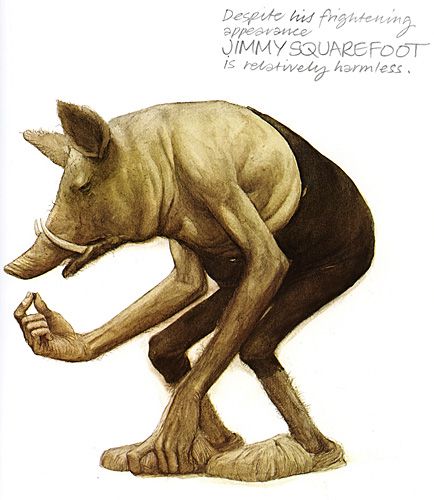
(The pigman is kind of just an orc replacement, specifically calling back to the orc from the original Little Brown Books, if the references to non-orcish non-porcine leadership and guarding caravans of treasure wasn't very obvious...)

Pigmen in service to an especially cruel sorcerer, priest, warrior, etc will oftentimes be found riding another strange and horrible creation... the manpig, a crouched and corpulent human with the mind of a pig, lacking the thought processes of a human and the life of a human. They are rather slow creatures, but wild boars kill pigmen almost on sight and the twisted forms of the pigman are uncomfortable on horseback. Camels are ridden too, at least in desert environs and for long distances, but in shorter distances cruel pigmen ride manpigs.

Manpigs are created in a ritual where a human mind and spirit are trapped in the body of a pig, while the pig's mind is brought into the human's body. There are numerous ways to fix this mindswap, but the most reliable is to perform a counter-ritual with both the pig possessed by the unwitting human and the manpig present. High level clerics are able to simply undo the sorcery by turning a manpig. Sometimes, the magic-user which created the manpig perishes and there is noone to switch the pigs and humans back, or the pig with the human mind trapped in it dies of its own accord. When such a state of affairs has passed, the ritual cannot be performed, and manpigs with no master will act as they wish. Oftentimes, they will eat the wizard that created them and then crawl out into the wilderness, rooting through the mud for roots and mushrooms, though wild boars will kill them on sight in disgust.

Manpig
Armor Class: 12
Hit Dice: 2 (9)
Attacks: 1 x bite (1d6+1 and disease)
To-Hit: +1
Movement: 150' (50')
Saving Throws: D12/W13/P14/B15/S16
Morale: 9
Alignment: Chaotic
XP: 25
Number Appearing: 0 (0)

Disease: The bite of a manpig carries a rotting disease. When bitten, the target must make a save vs. poison or contract a slow-acting rot that steadily makes the part of the body bitten pained and unusable. The character must be healed magically or with a special poultice for the disease to be cured.
Domestic: Not encountered in the wild. Typically ridden by pigmen or created by sorcerers.
Melee: When in melee, both rider and mount can attack.
Turning: Although they are not physically pigs, manpigs can be turned by clerics.

Monday, November 2, 2020

King of Kings City Folk

Something I quite like is simple character backgrounds or failed careers to help inform roleplay and provide a little bit of simple distinction between characters. It is also generally where I put in skill systems; a player can simply say that their character would reasonably know how to do something because of their former career from before they became an adventurer. These also bring with them a simple item or two that may become useful or may inform the character further. Failed careers in King of Kings are bundled together as parts of cultures, in a sense different communities of humans which can help inform a character's place in the setting.

Urban Shahanistanis

(As an aside, the term Shahanistani is used to refer to people or things originating in the Enlightened Empire. The term Shahanistan means "Land of Kings", the name of the ancient land that the Enlightened Empire currently occupies, so termed for the teeming innumerable petty overlords that seized power after the Heroic Age which followed the deluge)

Cities, with their tall walls and temples and houses clumping huddling together in clumps, dot the wilderness like flickering candles. The table below provides 30 failed careers for urbanites, which a player may roll on or choose from at character creation. In parentheses next to the failed career is whatever item(s) it provides a character.

(Note: There is no gender assumed for any of these failed careers, no matter the commonly gendered associations to many of them. The sole exception to this are the eunuch careers, who are eunuchs.)

1. Alchemist's Apprentice (a set of glass vials, metal tongs, a secret you never tell)
2. Bazaari (what remains of your wares, a dog on a leash, connections to suppliers)
3. Bird Catcher (a net, a knife, a frying pan)
4. Brick Layer (a loincloth, measuring tools, a good sense for architecture)
5. Corner Beggar (loose rags, a beggar's bowl, a few coins)
6. Cowguide (a whip, a loincloth, an aura of respect)
7. Cup Bearer (an ornate cup, soft shoes that step gently, youthful features)
8. Cynic Philosopher (a bowl, a walking stick, a reputation that precedes you)
9. Deserter (a stolen weapon, a bedroll and backpack, a heavy guilt weighing on you)
10. Disgraced Aristocrat (an ornamental weapon, a set of silken clothes, an immediately visible injurious scar)
11. Dye Worker (feet stained purple or red, a walking stick, bottles of many colored dyes)
12. Escaped Slave (hand made sandals, a knife, paranoid eyes glancing this way and that)
13. Executioner (a spike or garrote, a pair of leather gloves, an uneasiness which surrounds you)
14. False Eunuch (a knife, a key, a powerful person who hates you)
15. Fraudulent Merchant (false products, a silver tongue, a general hatred by everyone who shops in town)
16. Gang Member (a club, heavy leather boots, a boss that orders you around whenever they see you)
17. Guardsman (a pike, a cloth tunic emblazoned with bright colors, warm boots)
18. Haruspex (a knife, a hammer, a careful pair of eyes)
19. Herbad Priest (a pure white uniform, a veil, a book of holy poetry)
20. Inaccurate Astrologer (a telescope, a guide to the stars, intense stubbornness)
21. Lizard Breeder (a small lizard, a cage, thick protective gloves)
22. Masterless Eunuch (a distinctive uniform, a promise of restitution, lacking in certain departments)
23. Mystic Initiate (a rough and itchy mantle, memorized poetry, friends that nobody else knows)
24. Poet Lyrical (a musical instrument, a sweet sounding voice, a mind that incessantly thinks up poems)
25. Prostitute (a sensual outfit, a sweet smelling perfume, many friends in town)
26. Scholarly Scribe (a reed pen, an ink vial, a number of books you transcribed yourself)
27. Street Sweeper (a broom, a basket, intimate knowledge of a city's streets)
28. Student of History (well-worn sandals, a strong memory, uncanny ability to get people to open up)
29. Temple Bureaucrat (a large coinpurse, a goat, a dove)
30. Wall Painter (a set of paint brushes, 40' of rope, a wide brim hat)
(Oh and an additional note on historical inspiration to help provide context for one of these that might not be super clear: the false eunuch is a eunuch that was not actually castrated, which was a not uncommon phenomenon given one of processes common to perform such an act in the middle east (won't go into too much detail for the sake of those who don't wish to hear such things!). The Ottoman imperial harem which was guarded by eunuch African slaves had a not uncommon phenomenon of eunuchs that were not actual eunuchs having sex with some of the sultan's wives, in fact. This little bit of middle eastern history is what is being referenced by the false eunuch background; a eunuch employed by a powerful master who has had to flee for their life for the fact of their not being a full eunuch being revealed very suddenly.)

Thursday, October 29, 2020

Man of the Deluge

 In 1726, a naturalist, physician, and scholar from Switzerland named Johann Jakob Scheuchzer published a book. In this book, he detailed the physical characteristics of a fossil that he called Homo diluvii testis: Man, witness to the deluge. He believed that he had discovered the fossilized bones of a human being who had been crushed by the terrible weight of the very flood itself. He was very, very wrong of course; over the course of the centuries since then, naturalists have puzzled over it concluding at times that it was a giant catfish, a lizard, an olm, and finally (in 1811) a very large salamander. By 1837, the man of the deluge had a new name: Andrias scheuchzeri, Scheuchzer's image of man, in honor of its discoverer's antediluvian identification for it.

But what if Scheuchzer was right the first time?

Man of the Deluge

Not all of humanity was able to flee into the safety of the sorcerous bubble when the flood came. In fearful desperation, many hundreds crawled into the caves as the waters poured over the world, and could not crawl back out once it receded.

Deep beneath the surface of the world, where all is wet and dark and tight, the men of the deluge crawl on their bellies. They no longer look like humans, no longer think like humans, perfectly adapted for their cold blind environs. They speak only in chittering whispers that echo in the tunnels to communicate across long distances. They live primarily on cave fish and olms (which many spelunkers foolishly assume them to be).

Although they look nothing like humans, and their language is hard to understand, the men of the deluge are still intelligent. They can communicate with spelunkers via pointing and hand gestures, and although their half-blind eyes stare listlessly and thoughtlessly there is a mind with goals and thoughts behind it. They make and use tools, especially folding spears (to be stored away when traveling through tight cavern corridors) and hooks on strong lines of string. Negotiating with them may be quite difficult due to the language barrier and the simple fact that surface dwellers and cave dwellers have rather distinct concerns. But despite the bogeyman tales of cave demons that steal children away, the men of the deluge are not bloodthirsty (other cavern dwellers are bloodthirsty enough on their own).

On occasion, the men of the deluge are forced into submission by one of the myriad ancient tyrants of the deep ocean which dwell in the depths of the world. These alien intelligences use the isolated tribes of the cavern dwellers as their minions, though the blind men themselves generally do not favor such states of affairs.

By C.M. Kosemen

Man of the Deluge
Armor Class: 13
Hit Dice: 1+1
Attacks: 1 x weapon (1d6 or by weapon)
To-Hit: +1
Movement: 60' (20')
Saving Throws: D12/W13/P14/B15/S16
Morale: 7 (9 with tinker-shaman)
Alignment: Neutral
XP: 20
Number Appearing: 1d6+1 (4d8)

Half-Blind: The creature's eyes are almost useless. Immune to any effects which blind or otherwise incapacitate a creature's vision.
Tinker-Shaman: A magically-endowed craftswoman dwells in the lair of the men of the deluge. She has 4 hit dice, wields hand crafted weapons that deal 1d8+1 damage, and knows one level one spell that she can cast once a day. Cavern dwellers in service to sea tyrants will usually not have tinker-shamans.

Tuesday, October 27, 2020

Inventories and Encumbrance

 This is a bit less of a setting-specific post, but it is one of the few house rules that I will be using for King of Kings. I find that resource management is a very important part of the game, something which adds an important element of pressure on the players to really make their decisionmaking and exploration feel impactful. Well, this is something that plenty of other people have already said before. Here I'll just be describing my encumbrance rules so I can have them all in one place.

So that my inspirations can be openly available (and so I can link to other posts on this topic that I think are interesting and useful):
Mechanics for Resource Management Part 1 and Part 2
Across the Clones - Encumbrance
This compilation of resource management related posts from DIY & Dragons
Presenting the Only Good Encumbrance System
HMS Apollyon Exploration Rules

Okay, so to begin with: King of Kings is going to use slot-based encumbrance (rather than pound/stone/coin based encumbrance) where slots are only considered for significant items. This system of abstracting encumbrance away from the nitty gritty numbers of measuring specific weights of items allows it to have a more readily apparent impact on gameplay, with how it forces player decisionmaking and makes for easy encumbrance tracking.

Player characters have a number of inventory item slots equal to 10+STR modifier (modifier listed below):
3: -3
4-5: -2
6-8: -1
9-12: 0
13-15: +1
16-17: +2
18: +3
This allows for inventories ranging from 7 to 13 slots in size. This differs from the encumbrance system that I have typically used in my games up to this point. Normally, I have had the number of slots equal to the character's STR score, with some modifications based on race perhaps. However, this has oftentimes ended up with characters not interacting with the encumbrance system in a significant way, primarily because of just how high the values were oftentimes! Characters with very low STR scores simply didn't bother picking anything up, while characters with higher STR just never had to worry about it. By bringing it down to a more bounded range, it equalizes the system across all characters.

The first three of these item slots are "quick-draw" slots, items and equipment that the character has close on hand and can be pulled out at a moment's notice. During a combat encounter, items in the quick-draw slots can be used no problem. Items outside of the quick-draw slots require at least one round to retrieve (where the character is not doing anything but searching for that item), and due to the chaotic combat situation the character must roll 1d20 over the item's slot number in the inventory in order to retrieve it. If they fail this roll, they may attempt again, but it is very likely that enemy combatants will have noticed their helpless searching and decided to target them.

Fighters have a potential maximum of five quick-draw slots, allowing them to have more weapons/shields/etc with easy access. For slots four and five, the fighter character can choose whether they are quick-draw slots or normal item slots.

A character can carry up to their maximum amount of item slots without becoming encumbered. Going over the slot maximum encumbers the character, slowing them down and making them clumsier. 10 items over makes you heavily encumbered.

Encumbered: Act last in initiative order, -1 to all rolls, 50% chance of drowning, considerably slower than unencumbered characters for purposes of chases and retreats.
Heavily Encumbered: Act last in initiative order, -3 to all rolls (other than damage rolls), 100% chance of drowning, will always be captured in a chase unless items are abandoned, -2 to AC, cannot disengage from combat.

Specific Item Rules:

Weapons
Weapons are categorized into Light, Medium, and Two-Handed. Light weapons take up half an item slot (so two daggers take up one item slot), medium weapons take up one item slot, and two-handed weapons take up three item slots. Examples of light weapons include daggers and slings, examples of medium weapons include most swords and maces along with shortbows, and examples of two-handed weapons include large swords and longbows.

Ammo
A quiver of arrows or crossbow bolts takes up one item slot. For mundane missile weapons, the specific amount of arrows need not be tracked; it is assumed that an adventuring character has brought enough for their purposes, as long as they have "refilled" the quiver by paying for the associated price on returning to a settlement. A quiver must be in the character's quick draw slots in order to be used in combat. Special ammo should be tracked, with 20 such ammo pieces taking up one slot.

Armor
Armor is categorized into Light, Medium, and Heavy (or, to use more traditional terms, Leather, Chain, and Plate). Light armor takes up two item slots, medium armor takes up four, and heavy armor takes up six. Shields take up one item slot, and must be in the character's quick draw slots and be held in hand to receive the AC bonus.

Coins, Gems, and Treasures
Most small treasure items are not individually important enough to be considered to fill an item slot. 100 coins, gems, or small treasures occupy one item slot. 

Spellbooks and Grimoires
A book of magical spells must be put in the quick draw slots and be held in hand to be used. A single spell book takes up one item slot.

Torches and Lanterns
Three torches or one lantern take up one item slot. For torches or lanterns to provide light, they must be put in the character's quick draw slots and be held in hand. Five units of lantern fuel take up one item slot. A torch or lantern provides enough light for three people to see.

Pack Animals
Items can be stored on pack animals for travel and transportation. Typically, a pack animal or group of pack animals is left outside of the dungeon, but a small pack animal (mule) can be brought into a dungeon or other adventure location. The number of slots of items that a pack animal can carry varies. A mule can typically carry 10 slots of items, while a larger horse or camel can carry 15, and an elephant or giant lizard can carry 20. 

Thursday, October 22, 2020

Patrons in King of Kings

 In King of Kings, the characters are outcasts, criminals, paupers, foreigners, and travellers, people that are fundamentally outside of the local social order. There is plenty to explore in the social structures of the Sasanian Empire (which is the main inspiration for King of Kings), but in creating this setting I didn't necessarily want to build in a Skerples-style feudal hierarchy into character creation (though I definitely intend on writing more posts about social hierarchy in late antique Iran in future honestly). Even though I didn't want to establish a structured system for social hierarchy for characters, I did want social hierarchy to matter for the game... so, I concluded that the best way to do both of those things is to have players outside of the social hierarchy, but still make that hierarchy matter, through the player characters having someone that patronizes their activities!

Patronage and patron-client relationships have been a major part of just about all societies throughout history, though the most well understood (and perhaps one of the most well established, not to mention being where we even get the words "patron" and "client") is the Roman system of patronage, which was so prominent in Roman society that it was codified into law in many ways. Patronage did exist in ancient and medieval Iran (Shahanshah Kavadh patronizing the religious revolutionary Mazdak and Emir Abu Salih Mansur patronizing the epic poet Ferdowsi being two notable examples from Iranian history), but it never really attained the level of state codification that it did in Rome.

Those dynamics really interest me though! I don't really want characters that are expected to hold land or some temple office and not really have the time, ability, or independence to go on adventures; after all, this is a game of dungeons and dragons, its an adventure game. Something like Pendragon, where characters only go on adventures for a certain period of time and then come back to do administration and such, is interesting, but not what I'm going for. Trying to balance an Old School style adventuresome sword and sorcery with emulating the time period is a bit of a conundrum to be sure.

And so, enter the patron. The party as a whole has a patron in the area, most likely centered on a major city. They are rich and powerful enough to keep the party out of trouble most of the time, but not so rich, powerful, and most importantly not charitable enough to make the party's financial woes or social struggles just go away. Individual characters may have individual patrons, and may even gain such benefactors in game, but this does not concern us here.

Hey how about lets get some patrons hm? Roll 1d20 on each of the following tables.

Our patron is...
1: A jovial man with a long beard and large belly
2: A concubine of a city headman, conniving but kind
3: An elderly mobad that sees the party as misguided youths
4: A haughty merchant woman who simply doesn't have the time for you
5: A bandit gang leader, easy to anger
6: A wise and mysterious religious reformer
7: A world traveler that has only just settled down
8: An officer in the city's guard, paying the party beneath their superior's noses
9: A sorcerer-philosopher attempting to taxonomize the world
10: A village wise woman who has more social capital than coin
11: A member of the satrap's council who has become disillusioned with their station
12: A merchant house leader that eagerly sees opportunity for profit behind every corner
13: A wizard with nothing better to do
14: An upstart young magus in the religious hierarchy
15: A popular thief who has settled down but still wants to change things
16: A scholar hungry for secrets on the antediluvian past
17: A gourmand hungry to taste everything they can
18: A mystical teacher unwilling to initiate the players into deeper mysteries until they prove themselves
19: A rich foreigner with unknown motives
20: A distant and shadowy figure that the party never sees in person

They acquired their wealth and power through...
1: Lizard breeding (giant lizards, decorative lizards, assassination lizards)
2: A salt mine carved into the mountainside
3: Thievery. They just stole it all
4: Illegal currency sorcery
5: Horse and camel racing
6: An inheritance from a connection to some distant royal line
7: Their spouse, who really does all the work
8: Temple sacrifices and donations that they have skimmed off the top of
9: A deal with a demon that will bite them in the ass some day
10: Adventuring in their youth
11: A stipend from the satrap or from the shahanshah
12: Operating a business for assassinations
13: Fishing and caviar harvesting
14: A secret that they know about the satrap that they use as blackmail
15: The trade in rich furs (tiger, sable, lion, fox)
16: Swindling clients with faulty products (but you should trust them! promise!)
17: The spice and herb trade
18: Owning and operating a bar
19: The silk trade (oh what they wouldn't give for a few of the worms themselves...)
20: Owning and operating one or more textile workshops

The party as a whole has a value that represents their Rapport with the patron, and which allows them to ask the patron for favors. These can range from providing hirelings/retainers either at a cheaper rate or for free to intervening to assist the group in a jam and/or pickle. This begins at 10, and if it ever reaches 0 the patron will abandon the party altogether. When the characters maintain a good positive relationship with the patron, it goes up rather slowly (though the exact rate is up to the referee), while it increases by significant amounts (again, up to the referee) for missions or jobs that the patron requests the party do. Additionally, the patron will typically expect a portion of any and all treasure that the group brings back with them (roughly 10%). Oftentimes, there will be factions or leaders who despise the party's patron, and if they know of the group's connection to said patron, they will act in hostility (most like a -1 to -3 penalty on reaction rolls is in order if such a thing is immediately identifiable).

Also, just for fun, here's an example of a short list of free/cheaper hirelings and equipment available from a patron (derived from a random patron prompt from the two tables above!)

Patron: An upstart young magus in the religious hierarchy who acquired their wealth and power through an inheritance from a distant royal line
Temple cupbearer*              1 Rapport
Street thug**                      3 Rapport and 20 gold
Sacrifice bureaucrat***        3 Rapport and 10 gold
Herbad****                         30 Rapport and 250 gold
Pony                                 10 Rapport and 50 gold (+50 gold for ceremonial armor)
Bird of paradise                  10 Rapport and 100 gold
Lantern                              2 Rapport and 5 gold
Scroll of fireball*****            100 Rapport and 10,000 gold

*A young boy who carries golden and silver cups in temple ceremonies. Can easily carry torches, etc.
**A rambunctious youth bribed and cowed into service by the magus's connections. Potentially a friend of a friend of the priest.
***An older priest trained with the ability to identify the living or dead body of any animal simply through familiarity
****A priest in training, functions as a henchman that expects a cut of the treasure. Level one cleric or magic-user.
*****An incredible gift, not to be used unwisely. They had to pull a lot of strings to get this to you.

Tuesday, October 20, 2020

The Huma Bird

 Yknow, for someone who got into the tabletop roleplaying hobby primarily through monster books, it is really a surprise to me that I haven't posted a monster to this blog yet! So hey, here is the first in what will most likely be a long line of posts writing up interesting monsters for King of Kings and other old school games.

The Huma Bird

Now the Humay stood before the assembly, the Giver of Shade, whose shadow bestows pomp on kings. For this he has received the name of 'Humayun', the fortunate, since of all creatures he has the most ambition. He said: 'Birds of land and sea, I am not a bird as you are. A high ambition moves me and to satisfy it I am separated from other creatures. I have subdued the dog of desire, therefore are Feridun and Jamshid dignified. Kings are lifted up by the influence of my shadow, but beggarly-natured men do not please me. I give a bone to my dog of desire and put my spirit in surety against it. How can men turn their head away from him whose shadow creates kings? Beneath my wings everyone seeks shelter. Do I need the friendship of the lordly Simurgh when I have royalty at my disposition?'

- Attar of Nishapur, The Conference of the Birds

The huma is a great bird of the air, which is immediately known by its two heads and beautifully many hued plumage. It has four legs and two wings, but it never once touches the earth beneath it, instead preferring to stay high in the clouds on the wing. If the huma is ever forced to touch the ground, it will screech so loudly in disgust and discomfort that all around recoil in pain. The huma is both male and female, each head having one respective aspect. 

The shadow of the huma bird bestows kingship and a bountiful future on all those who pass beneath its shadow. A farmer who has the huma's shadow cast upon him will have a great harvest and may well become the headman of his community, or perhaps even something greater. A herdswoman who steps into the shadow of the huma will come to have too many sheep in her hands than she can handle, and will earn the respect of all those around her. In the ancient capital city of the Enlightened Empire, there is a captured huma bird in a great big cage who casts its shadow on the chosen heir in a ceremony full of pomp and circumstance prior to their being crowned. Although rather fleeting, the shadow of the bird or even a simple glance at it are incredibly valuable. 

The huma is the most mighty and auspicious of birds. It is not a sight to be ignored. The corpse of a huma bird is a horrible sight, the death of a huma something that brings with it funeral processions and teary-eyed cries of desperation. Even those who kill the bird feel a great weight of guilt on their shoulders from that day on. The scholars and magi believe there to be only a certain number of huma birds, for there have never been seen any eggs or hatchlings. 

Huma Bird
Armor Class: 15
Hit Dice: 9+1 (42 HP)
Attacks: 2 x claw (1d6), 2 x bite (2d8)
To-Hit: +8
Movement: 120' (40') / 360' (120') flying
Saving Throws: D8/W9/P10/B10/S12
Morale: 6
Alignment: Neutral
XP: 900
Number Appearing: 1-4 (1d4)

Huma birds will not normally attack unless provoked (or on a result of 2 on the reaction roll). When a huma bird is killed, all those who can see it must make a save vs. spells or begin to cry. A character's reputation will be greatly marred by killing the bird, and any who know of the act will shun them.

Those who are able to pluck a feather off of the huma bird will be able to sell it for 200 gold per feather to the right buyer. Feathers can also be affixed to any items of clothing (most commonly headwear such as helmets or crowns), and all persons who see them with the feathers on them will treat them with respect.

Characters may attempt to capture the huma bird using a lasso, rope, etc. In so doing, they will only get XP from the captured bird upon bringing it to a town. Rich notables and paupers alike will pay handsomely to step into the bird's shadow (handsomely being, of course, relative to the level of wealth they have access to). If, while being captured, the huma is dragged to the ground, it will screech so loud that all who are within earshot and can hear must make a save vs paralysis or drop their ropes and tools.

Also hey how about some nice simple lassoing rules to help with catching one of these beautiful beasts

A character with a lasso (or similar item) may attempt to wrangle a beast within a distance equal to the lasso's length (they typically range from 50 feet to 100 feet in length). The initial throw of the lasso functions as a simple d20 roll under DEX score (as an aside, if a character has experience with lassoing beasts for whatever reason, I would either give them a flat improvement to the check or let them roll twice and take the better result, really depends). If this DEX roll succeeds, then the lasso is around the creature's neck, and a struggle begins. Each subsequent round, the player holding the lasso and the referee each roll a d20; if the creature being lassoed rolls higher, it pulls away and escapes, if the player rolls higher the creature remains in the lasso. The player holding the lasso adds their STR modifier (the melee modifier) to the roll, and any other characters helping them hold the lasso do as well (a minimum of 0; negative modifiers don't affect it, don't worry). The creature being lassoed adds its hit dice number (including any bonus) to its roll, with the bonus going down by 1 for every 8 hit points it loses.

(Okay maybe it isn't as simple as I thought it was in my head but its not that hard! I like the monster's bonus slowly lowering as it takes damage; incentivizes the players to try to balance beating them up and holding them down)

So, to use the huma bird as an example. If the players try to lasso a huma bird, the bird would have +10 to the opposed d20 roll, while the players could potentially stack multiple people holding the rope. If there are more than one huma bird, the other birds will likely be trying to break the rope to free their sister-brother, and perhaps some fighter-type characters would be trying to beat up the one in the lasso while also trying to fend off other birds. A very hectic scene indeed!

Sunday, October 18, 2020

Diagnosis: You're a Wizard

 While I might not be the biggest fan of all of the prestige classes and feats and characters options and whatnot in 3e (and by extension in pathfinder), there are a good few options from that period of DnD's history that I am absolutely enamored with. I've never actually played 3e or 3.5e for any lengthy period of time, but I've ended up accruing a not insignificant number of 3e books over my years of interest in the hobby, mostly monster books (by far my favorite kind of RPG books and also my introduction to tabletop gaming, before I even knew what tabletop gaming was). One of the most interesting ones that wasn't a monster book, however, was the Book of Vile Darkness, the only Dungeons and Dragons book to be released with a parental advisory sticker on it warning about adult themes.

Adult themes like... demons and killing things and being eeeevil. Ignore the self confident parental advisory sticker, the Book of Vile Darkness was just over the top edgy saturday morning cartoon goth evil stuff. And I LOVE THAT. I love that aesthetic so so much more than if the book was actually serious adult content. So hey, here is one of my favorite prestige classes from the book, written up for Old School Essentials! (considered making a GLOG version but realized I'm not familiar enough with the GLOG to do that). It's a spooky time of year so why not have a bit of a spooky class. Oh, also I did attempt this once before on my old blog, but that one was written for 5e and hopefully this one will be better. I might do the same thing with some other character options from that period of DnD that I like... which isn't a huge amount, but there are a few!

The Cancer Mage
A class for use with Old School Essentials (or any similar ruleset)

Requirements: Minimum CON 9, Must be Neutral or Chaotic in alignment
Prime Requisite: CON and INT
Hit Dice: 1d4
Maximum Level: 14
Armor: Leather only, no shields
Weapons: Dagger

A cancer mage with at least 13 in one prime requisite gains a +5% bonus to experience. If both CON and INT are 16 or higher, the brineman gets a +10% bonus.

Arcane Magic
Not going to write out all of the OSE rules for magic here, just suffice to say that they can cast spells like magic-users, can use magical items, etc. However, they can only start casting spells at second level, and cannot do magical research.
Back-stab
When attacking an unaware opponent from behind, a cancer mage receives a +4 bonus to-hit and doubles any damage dealt.
Cancerous Companion
Beginning at level two, a large tumor endowed with intelligence grows on the cancer mage. They have a personality distinct from the mage, but the two share all ability scores and saves. The cancerous companion is able to see in all directions around the mage out to a radius of 30 feet, and will alert the cancer mage of any danger they see. At level four, mind-affecting spells (such as charms, illusions, etc.) have a 50% chance of only affecting the companion. At level six, the radius that the cancerous companion can see out to is expanded to 60 feet. At level nine, the cancerous companion is able to cast a spell that the cancer mage just cast at no spell slot cost for the cancer mage, once per day.
Contagious Touch
The touch of the cancer mage spreads disease. Whenever the cancer mage touches a living animal (spirits, demons, constructs, undead, plants, and fungi are not affected), the creature must make a saving throw vs. poison or contract a random disease that the cancer mage is currently carrying. Beginning at level five, the cancer mage is able to select which disease a target is infected with.
Disease Host
The cancer mage is host to every disease that they have come in contact with. They begin play carrying only one disease, randomly chosen from the table below. Any disease they come in contact with over the course of the game should also be kept track of. Although the cancer mage visibly shows symptoms of these plagues, they are not able to die from them.
Roll 1d8
1. Bubonic Plague
2. Chicken Pox
3. Dancing Plague
4. Leprosy
5. Measles
6. Polio
7. Rabies
8. Smallpox
(These diseases can easily be switched out for more setting-appropriate ones, I just wanted to use some ones from real life so as to not rely on any setting-specific things)
Skills
Cancer mages can use the following skills, with the chances of success shown below:
Hide in Shadows (HS) (Begin at 10% chance of success, increase by 5% each level)
Move Silently (MS) (Begin at 15% chance of success, increase by 5% each level)
After 11th Level
A cancer mage is able to establish a secretive coven to initiate others into the close relationship with disease that so defines the mages. They attract 1d10 level one cancer mages, thieves, and magic-users, who will learn spells and techniques from them. 

Source

Cancer Mage Character Progression
XP to Level 2:
2,600
Fighting Advancement: as Magic-User
Saving Throws at Level 1: 
    Death/Poison: 11
    Wands: 15
    Paralysis/Petrify: 16
    Breath Attacks: 16
    Spells/Rods/Staves: 12
Spell Advancement: as Cleric

Source

Also, since this is considerably pared down from the original 3e cancer mage, I chose to turn some of the class features that the class originally had into spells, so here are those!

Children of the Night
Level: 2
Duration: 4 turns
Range: 100'
The caster calls forth a number of small creatures from the dark recesses surrounding them. The creatures summoned follow the caster's mental commands, but do not follow the commands of any others. The creatures that can be called forth include: 
5d6 bats
3d6 cave locusts
2d4 killer bees
2d6 giant black widows
2d6 pit vipers
3d6 giant rats
1d6 rhagodessa
2d4 robber flies
3d6 spitting cobras
5d6 stirges
1d6 giant toads

Viral Agent
Level: 3
Duration: 1 day
Range: 5 miles
The caster endows a disease that they host in their body with intelligence. They must sacrifice a point of intelligence when casting the spell. They are able to communicate telepathically with the disease while it is within the spell's range, and the disease will inform them of what their host experiences. If any other person(s) are infected with the disease, the caster is able to receive information from all such hosts. 

Insect Armor
Level: 2
Duration: 3 turns
Range: The caster or a creature touched
The target of the spell is covered by crawling insects for the duration of the spell's effect. This grants them a +4 bonus to their armor class, and the ability to climb on walls and ceilings. This armor class bonus is, however, negated by any attack which would hit a large part of the subject's surface area i.e. a large hammer strike, as the insects crawl out of the way to defend themselves from the damage.

Can you believe people are making halloween masks of covid?? A little insensitive if you ask me, even if I do love these horrible slimy goblin lookin critters
Disease Form
Level: 5
Duration: two weeks (can be cancelled at any time)
Range: The caster
The caster transforms into a microbial disease, and is able to infect anyone that comes in contact with them. Any items that the caster has on their person does not transform with them. Any living animal (this does not affect spirits, demons, constructs, the undead, plants, or fungi) that comes in contact with the caster while they are in disease form must make a save vs. poison or contract the caster. After an initial incubation period of 24 hours, the caster in disease form begins dealing 1d3 damage to the host's CON per day. If CON reaches 0, the host dies. Each day that the caster is in disease form, they can roll 1d20, hoping to roll higher than the host's current CON score. If this roll succeeds, then the caster takes control of the host for the remaining duration of the spell. Any living animal that comes within 5 feet of the host contracts the caster as well, but the caster is only able to control one host at a time.